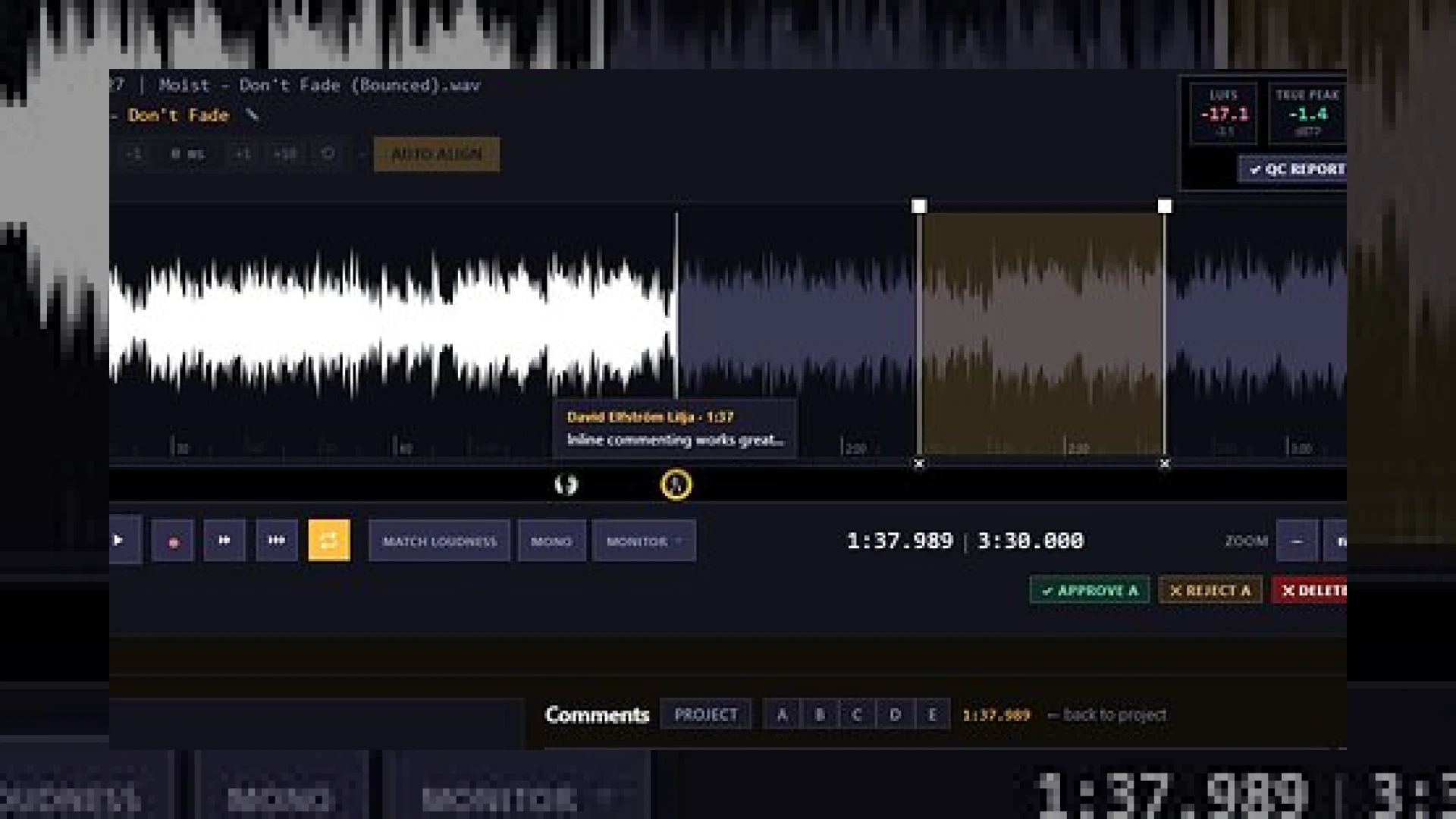
Visual context for I/O Music release Talkback.
In the modern remote audio production landscape, receiving clear, actionable feedback on your mixes and masters can be a tedious process of endless emails, misaligned timestamps, and level-matching issues. The recent **i/o music release talkback** addresses this challenge head-on by delivering a streamlined, all-in-one web environment specifically designed for artists, mixing engineers, mastering houses, and record labels to collaborate seamlessly. This web-based application replaces generic file-sharing platforms with a feature-rich workspace tailored specifically to the needs of professional audio creators.
Streamlining Workflows with the I/O Music Release Talkback
The core philosophy behind the **i/o music release talkback** is to remove the friction from the client feedback loop. One of its standout features is the instant A/B/C mix comparison tool. Unlike basic media players, Talkback maintains the exact playback position when you switch between different versions of a track. This allows clients and engineers to compare subtle adjustments in real-time.
Furthermore, a built-in Match Loudness function ensures that level differences do not bias the listener’s judgment, which is a common psychoacoustic trap during mixing and mastering. While premium plugins from developers like iZotope focus on the creation and processing stages of audio, Talkback bridges the critical communication gap that occurs right before the final release.
Advanced Analysis and Codec Previews
The **i/o music release talkback** is not just a communication channel; it is a robust quality-control environment. For mastering engineers who require technical precision, the platform offers deep analytical insights directly on the web. It provides immediate measurements of:
- LUFS: Integrated and short-term loudness monitoring.
- True Peak: Ensuring files remain below clipping thresholds.
- LRA (Loudness Range): Evaluating the dynamic spread of your track.
Additionally, the tool generates a comprehensive QC report that issues clear pass, warning, or fail alerts based on DC offset, digital clipping, and true-peak overs. To make things even better, users can audition their files through various streaming codec previews. This allows you to hear exactly how the lossy compression algorithms of Spotify, Apple Music, Tidal, Deezer, and YouTube Music will affect your transients, stereo image, and high-frequency response before committing to distribution.
Talkback Technical Specifications
| Specification / Feature | Functional Use | Details / Compatibility | User Rating |
|---|---|---|---|
| Platform Type | Collaboration & Quality Control | Web-based application (No install required) | 4.8 / 5.0 |
| Loudness Matching | Unbiased level matching for A/B/C comparisons | Automatic, real-time gain alignment | 4.9 / 5.0 |
| Analysis Metrics | Technical QC and standards compliance | LUFS, True Peak, LRA, DC Offset, Clipping | 4.7 / 5.0 |
| Codec Auditioning | Streaming platform translation checks | Spotify, Apple Music, YouTube, Tidal, etc. | 4.9 / 5.0 |
Practical Studio Workflow Integration
Incorporating the **i/o music release talkback** into your daily routine can drastically reduce revision cycles and keep your mastering projects organized. Here are some actionable integration tips:
- Keep Playback Consistent: When presenting mastering revisions to a client, upload them to the same A/B/C player. Instruct the client to toggle between versions mid-chorus to pinpoint specific EQ or compression adjustments without losing their place.
- Leverage the Overdub Feature: Encourage vocalists or producers to use the built-in overdub option. They can record voice notes or hum ideas directly over specific parts of the track, ensuring there is zero room for misinterpretation.
- Run QC Checks First: Before sending files to digital aggregators, run them through the platform’s automated QC system to catch rogue inter-sample peaks or unwanted DC offset.
- Keep Client Education in Mind: Use the codec preview feature to explain to clients why a slightly quieter master with more dynamics often translates better across streaming networks than an overly brickwalled file. Learn more about mastering delivery standards on our dedicated portal: SM Mastering Audio Articles.
Conclusion
Ultimately, the **i/o music release talkback** proves to be an indispensable utility for the modern independent audio ecosystem. By combining high-resolution file comparison, rigorous loudness matching, integrated QC analytics, and target-platform codec previews into a single browser window, Swedish label I/O Music has designed an elegant solution to an industry-wide headache. Whether you are a solo artist seeking external feedback or a busy mastering house managing multiple EP revisions, this platform will streamline your pipeline and protect your creative vision.
Frequently Asked Questions
How does the Match Loudness feature in Talkback work?
The Match Loudness function automatically calculates the integrated loudness of your uploaded audio files and offsets their playback gains in real-time. This ensures that when you or your clients toggle between mix revisions (e.g., Mix A vs. Mix B), the volume remains perfectly consistent, eliminating the natural psychoacoustic tendency to prefer the louder file.
Can clients leave comments at specific times on the track?
Yes, Talkback features interactive, timestamped feedback options. Listeners can pause the track at any exact moment, type their notes, or even record a direct audio overdub to explain complex changes clearly.
What streaming platforms are simulated in the codec preview engine?
The platform supports real-time auditioning of compression algorithms modeled after popular services, including Spotify, Apple Music, YouTube Music, Tidal, Amazon Music, and Deezer. This lets you hear the artifacts and compression characteristics of each encoder before final bouncing.
🛒 Official Product Info & Where to Buy
Check full technical specs, pricing, and purchase options directly from the official manufacturer or authorized dealer for I/O Music release Talkback.

Written by SM Mastering
Official content on sound engineering, mixing, mastering, and advanced electronic production by SM Mastering.