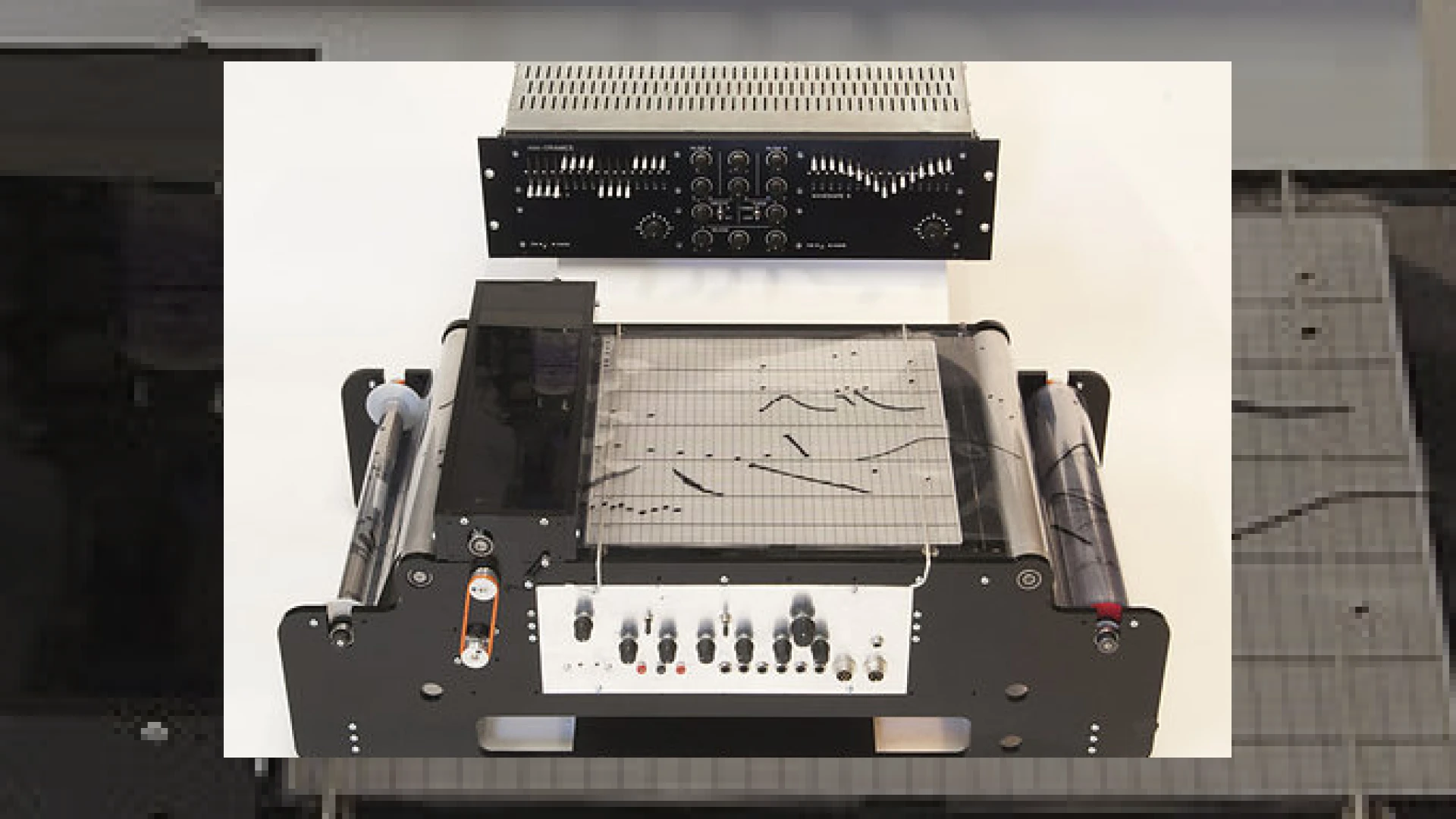
Visual context for Legendary Mini-Oramics machine to make a rare public appearance.
The history of electronic music is paved with visionary inventors who reshaped how we conceptualize sound creation. Among these pioneers, Daphne Oram stands as a towering figure. As the co-founder and first director of the legendary BBC Radiophonic Workshop, Oram revolutionized the industry by inventing “Oramics”—a groundbreaking form of “drawn sound” synthesis. While her original 1960s machine was the size of a large office photocopier, her dream of a portable version remained unfinished during her lifetime. Decades later, the electronic music community is buzzing with excitement over the announcement of the legendary mini-oramics machine to make a rare public appearance at SynthFest UK, giving modern producers and historians an unprecedented look at this optical marvel.
For those of us in the professional mastering field, understanding the physics of wave generation is crucial. Daphne Oram’s approach bypassed traditional keyboards, allowing composers to paint wave shapes directly onto film strips. At SM Mastering, we frequently analyze how these vintage analog principles dictate modern digital processing; you can learn more about this on our SM Mastering Audio Articles hub, where we bridge the gap between historic synthesis and cutting-edge mastering workflows.
Understanding the Legacy: Legendary Mini-Oramics Machine to Make a Rare Public Appearance
The original Oramics machine used multi-track 35mm film strips with hand-drawn ink curves to control pitch, volume, timbre, and vibrato. In the 1970s, Oram began working on the Mini-Oramics machine to make her optical synthesis format more accessible and compact, but the project was never completed. Thanks to the monumental research and engineering efforts of PhD student Tom Richards at Goldsmiths, University of London, the design has been painstakingly re-imagined, engineered, and built into a fully operational instrument.
With the legendary mini-oramics machine to make a rare public appearance, modern producers can witness firsthand the optical system that preceded today’s graphic automation. In many ways, Oram’s vision predicted the visual, vector-based automation interfaces we take for granted in modern digital audio workstations like Ableton. Seeing this physical ancestor of modern graphic synthesis in action is a humbling reminder of how far music technology has progressed, and how forward-thinking Oram truly was.
Technical Specifications of the Mini-Oramics Machine
To understand the mechanics behind this rare device, let us look at the structural and functional breakdown of Tom Richards’ reconstructed design:
| Specification / Feature | Details & Description | Estimated Value / Status | Historical Rating |
|---|---|---|---|
| Instrument Name | Mini-Oramics (Reconstructed Prototype) | N/A (Academic Masterpiece) | ⭐⭐⭐⭐⭐ (5/5) |
| Synthesis Method | Opto-electronic “Drawn Sound” Synthesis | Custom Optical Readers | ⭐⭐⭐⭐⭐ (5/5) |
| Control Interface | Hand-drawn ink on clear slides/strips | Manual Graphical Control | ⭐⭐⭐⭐☆ (4.5/5) |
| Current Location | Goldsmiths, University of London / Public Exhibition | Priceless / Not for Sale | ⭐⭐⭐⭐⭐ (5/5) |
For audio restoration experts and those who study historic sound design, the legendary mini-oramics machine to make a rare public appearance offers a masterclass in early waveform generation. By converting hand-drawn patterns into electrical signals via photoelectric cells, the machine generates pure, organic analog waveforms that carry an inherently imperfect, beautifully warm aesthetic.
Practical Studio Workflow: Applying the “Drawn Sound” Philosophy
While most of us do not have access to an optical film synthesizer in our daily studio operations, we can easily adopt Daphne Oram’s visual workflow philosophies to inject unique character into modern productions. As we prepare for the legendary mini-oramics machine to make a rare public appearance, let us look at how these optical synthesis principles apply to modern mastering and mixing workflows:
- Drawn LFOs and Automation: Instead of relying on standard sine or triangle LFOs, use your DAW’s envelope pen tool to draw asymmetrical, hand-crafted modulation shapes for filters and panning. This mimics the organic, human-error-prone nature of Oram’s hand-drawn slides.
- Spectral Editing and Sound Design: Use spectral repair software to literally “paint” away or paint on harmonics within the frequency spectrum. This is the direct digital evolution of optical synthesis.
- Emulating Opto-Electronic Compression: Opto-compressors use light-dependent photoresistors to control gain reduction, much like the photoelectric cells in the Mini-Oramics machine. Lean on opto-style processors to achieve smooth, musical leveling on vocals and master busses.
Conclusion
The reconstruction of the Mini-Oramics machine by Tom Richards is more than just an academic triumph; it is a living bridge to the roots of electronic composition. Daphne Oram’s legacy continues to inspire modern synthesis, mastering engineering, and sound design. Catching this machine live at SynthFest UK is an absolute must for anyone serious about the history of audio technology. It serves as a beautiful reminder that before there were pixels and computer screens, sound was shaped by hands, ink, light, and pure imagination.
Frequently Asked Questions
What is the Mini-Oramics machine?
The Mini-Oramics is a compact, portable version of Daphne Oram’s original “Oramics” machine. It utilizes an opto-electronic synthesis method where a composer draws graphic patterns directly onto film strips, which are then read by photoelectric sensors and converted into audio waveforms.
Who built the working model of the Mini-Oramics?
The functional Mini-Oramics machine was built by PhD researcher Tom Richards at Goldsmiths, University of London. He meticulously re-imagined and completed Daphne Oram’s unfinished 1970s notes to create a fully working prototype.
Where can I see the Mini-Oramics machine in public?
The machine will make a highly anticipated public appearance at SynthFest UK, where visitors can attend a seminar, see a live demonstration, and even try their hand at drawing sound patterns to be played back by the instrument.
Written by SM Mastering
Official content on sound engineering, mixing, mastering, and advanced electronic production by SM Mastering.