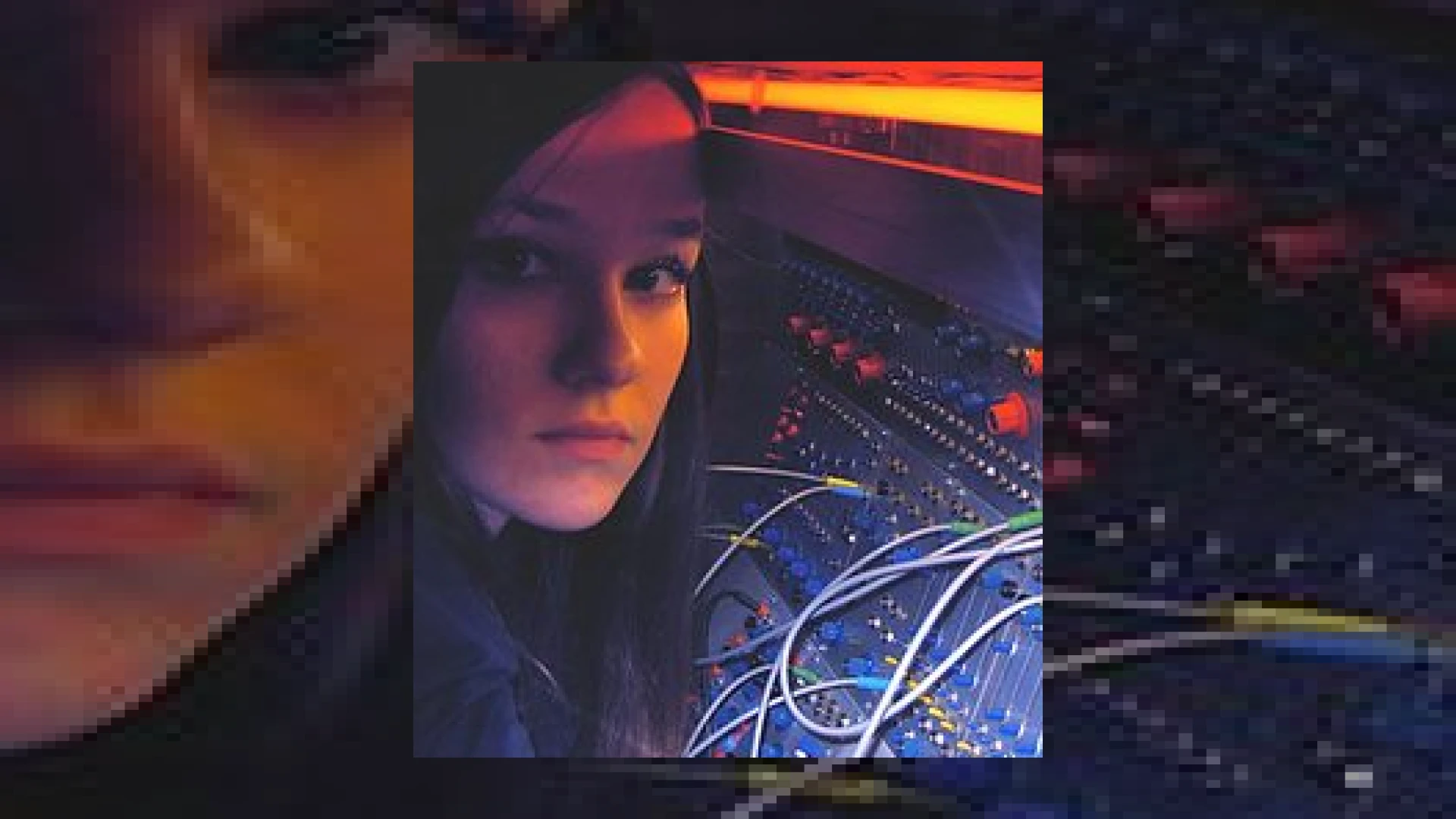
Visual context for Interview: minimalist electronic artist Caterina Barbieri.
Welcome to SM Mastering’s latest artist spotlight, where we analyze the sonic architecture of modern modular music. In this deep dive, we reference an insightful interview: minimalist electronic artist caterina barbieri to explore how minimalist synthesis interacts with psychoacoustic principles. As mastering engineers, we are constantly fascinated by how minimal arrangements occupy the stereo field and dynamic range, proving that less is indeed more when it comes to high-fidelity playback systems.
Caterina Barbieri, a Berlin-based Italian composer, has taken the modular synthesizer world by storm. Her breakthrough 2017 record, Patterns of Consciousness, was met with critical acclaim for its hypnotic, pattern-based approach to composition. Originating from a classical guitar background at the Conservatory in Bologna, Barbieri transitioned into electronic music through her exploration of noise and metal. This classical foundation, combined with an educational immersion at the Royal College of Music in Stockholm, birthed a highly mathematical yet deeply emotional approach to sound synthesis.
A Masterclass in Sonic Reduction: Interview: Minimalist Electronic Artist Caterina Barbieri
The turning point in Barbieri’s career came in 2013 when she encountered the legendary Buchla 200 system in Stockholm. “The Buchla taught me a way of listening to sound that years of training in classical music never taught me,” she reflects. “Suddenly I started hearing all this subatomic dance of particles wrapped in a waveform.” This realization transformed her perspective from traditional linear composing to micro-level physical sculpting of voltage-controlled frequencies.
Throughout our analysis of this interview: minimalist electronic artist caterina barbieri, she emphasizes her rejection of standard vintage tropes. Instead of leaning on nostalgic analog imperfections, she utilizes precise, pristine waveform generation. This clinical control over harmonics and phase is a dream for mastering engineers, as it provides an incredibly clean canvas to maximize perceived loudness and spatial depth without introducing unwanted harmonic distortion.
The Aesthetic of Limitation: Avoiding Iconic Timbres
One of the key takeaways from Barbieri’s workflow is her deliberate decision to bypass recognizable, iconic synthesizers. While many electronic producers seek out vintage analog emulations to add instant warmth, Barbieri opts for simple, fundamental waveforms. By stripping away complex, pre-designed timbres, the listener is forced to engage with the temporal structure and geometry of the music itself. She builds polyphonic patterns out of monochromatic tones, using subtractive and additive techniques to create shifting psychoacoustic illusions.
From a technical mastering perspective, this clean approach presents unique challenges and opportunities. Without the masking effect of dense distortion or busy arrangements, every transient, frequency clash, and phase anomaly is exposed. Achieving a competitive master for this style of music requires extreme precision, transparent limiting, and surgically targeted dynamic equalization to ensure the synthesized patterns translate perfectly across club systems and consumer headphones alike.
Gear and Software Specifications
While Barbieri’s philosophical approach is deeply abstract, her physical tools are highly specialized. Below is an overview of the key components that define her signature modular and digital production environment:
| Name | Use | Price (Approx.) | Rating |
|---|---|---|---|
| Buchla 200 Series / 200e | Generative synthesis, spatialization, and complex modulation | $15,000 – $30,000 | 5 / 5 |
| Orthogonal Devices ER-101 | Sequencing complex, non-repeating algorithmic patterns | $700 | 4.8 / 5 |
| Ableton Live Suite | Multitrack recording, processing, and arrangement integration | $749 | 4.9 / 5 |
| Verbos Electronics Complex Oscillator | Primary west-coast style synthesis voice | $650 | 4.7 / 5 |
For artists looking to emulate these spatial and structural workflows inside the DAW, utilizing powerful sequencing environments like Ableton Live is an excellent starting point for generative MIDI routing and synthesis modulation.
Practical Studio Workflow Tips for Minimalist Electronic Music
If you are inspired by the sound design and compositional philosophy discussed today, here are some actionable studio techniques to elevate your productions:
- Embrace Phase Alignment: When working with pure waveforms (like sine or triangle waves), ensure your low frequencies are perfectly in phase. Even minor phase cancellation can completely destroy the low-end energy of a minimal track.
- Restrict Your Toolset: As we discovered in this interview: minimalist electronic artist caterina barbieri, limiting your sound sources allows you to focus purely on composition. Try writing an entire track using only one synthesizer and one sequencer.
- Master the Stereo Field: In minimal arrangements, use subtle panning and psychoacoustic delay (like the Haas effect) to make static synthesizer voices feel alive and dynamic without cluttering the center of the mix.
- Leave Room for Mastering: Minimalist music relies heavily on transients. Keep your master bus completely free of heavy compression or brickwall limiting during the mix stage, allowing your mastering engineer the headroom needed to make those transients pop.
Conclusion
Caterina Barbieri’s music serves as a profound reminder that electronic music does not need density to achieve intensity. By focusing on pure waveforms, complex temporal structures, and the raw physics of sound, she creates works that are both intellectually stimulating and deeply emotional. To master tracks with this level of transient intensity, refer to our comprehensive mastering guides on the SM Mastering Audio Articles portal, or review the concepts outlined in this interview: minimalist electronic artist caterina barbieri to redefine your relationship with sound design.
Frequently Asked Questions
What synthesizer is Caterina Barbieri famous for using?
Caterina Barbieri is highly associated with the Buchla 200 and Buchla 200e modular systems. She has also extensively used Eurorack format modular synthesizers, emphasizing West Coast synthesis techniques to generate complex harmonic timbres from simple, fundamental waveforms.
How does minimalist electronic music benefit from professional mastering?
Because minimalist music features sparse arrangements and clean waveforms, any technical flaw (such as phase cancellation, sub-bass rumble, or transient harshness) is easily heard. Professional mastering ensures that the dynamics, frequency balance, and spatial imagery of these subtle elements are perfectly optimized for various playback systems.
What is “West Coast” synthesis?
West Coast synthesis, pioneered by Don Buchla, focuses on generating complex harmonic structures from simple waveforms (like sine waves) using wave folding, frequency modulation (FM), and low-pass gates. This differs from East Coast synthesis (pioneered by Bob Moog), which typically uses complex waveforms (like saw or square waves) and filters them down using subtractive synthesis.

Written by SM Mastering
Official content on sound engineering, mixing, mastering, and advanced electronic production by SM Mastering.