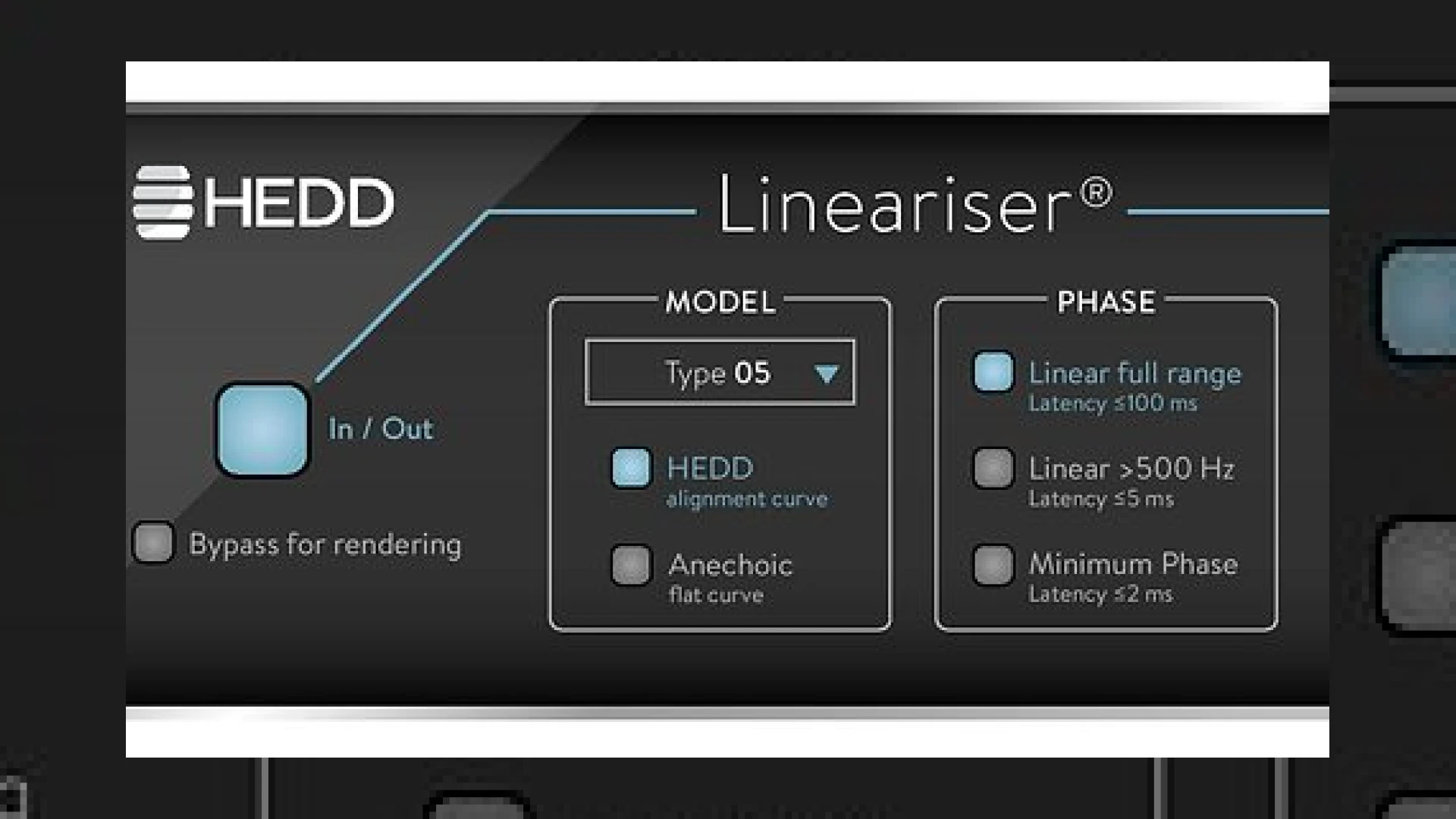
Visual context for HEDD Lineariser plug-in addresses monitor phase.
In the high-stakes world of audio mastering and critical mixing, phase coherence is often the dividing line between an amateur mix and a commercial master. German studio monitor pioneer Heinz Electrodynamic Designs (HEDD), founded by industry veteran Klaus Heinz, has tackled one of the most persistent physical challenges in loudspeaker design: group delay and phase distortion. For professional mastering and mixing engineers, the hedd lineariser plug-in addresses monitor phase issues directly, using an elegant software-based solution to correct the time-alignment of different frequencies.
Unlike traditional approaches that rely on internal DSP chips within the speaker cabinet, HEDD has opted to offload this processing to the host computer’s CPU. By shifting this processing to the DAW level, the hedd lineariser plug-in addresses monitor phase without requiring any extra AD/DA conversion stages. This ensures the absolute preservation of your original analog signal path while maximizing the resolution of your audio files up to 192 kHz and 32-bit depth.
How the hedd lineariser plug-in addresses monitor phase
In any multi-way loudspeaker, different frequencies reach the listener’s ears at slightly different times due to the physical separation of the drivers, crossover filters, and cabinet acoustics. This phase misalignment smears transients and compromises the stereo image. The way the hedd lineariser plug-in addresses monitor phase anomalies is by applying complex, FIR (Finite Impulse Response) filtering to reverse these time delays before the audio signal even leaves your computer.
By correcting these errors in the digital domain, your physical HEDD monitors behave as a perfect point-source system. Leading acoustic designers, including those at industry giants like Neumann, have long recognized the impact of phase alignment on spatial localization. When the hedd lineariser plug-in addresses monitor phase inaccuracies, the soundstage instantly widens, depth perception becomes highly defined, and transient response becomes lightning-fast and ultra-precise.
For more deep-dive analyses on room acoustics, monitoring setups, and mastering techniques, feel free to explore our collection of SM Mastering Audio Articles.
HEDD Lineariser Specifications
To help you understand the integration of this tool in your environment, we have compiled the core specifications of the software below:
| Specification Name | Details & Compatibility |
|---|---|
| Plugin Name | HEDD Lineariser® |
| Primary Use | Phase and Frequency Correction for HEDD Monitors |
| Format Support | VST, AU, AAX (32-bit & 64-bit) |
| Internal Resolution | Up to 192 kHz, 32-bit floating point |
| Price | Free for HEDD Monitor Owners |
| SM Mastering Rating | 9.5 / 10 |
Practical Studio Workflow Tips
Integrating a phase-correction plug-in into your daily studio routine requires some deliberate setup. Here are some professional recommendations from our team at SM Mastering:
- Insert Position: Always place the plugin at the very end of your master bus chain or control room output. Ensure no other processing (like limiters or dither) occurs after it.
- Select the Right Phase Profile: The software offers three phase settings (Linear Full Range, Linear above 500 Hz, and Minimum Phase). Use ‘Linear Full Range’ for critical mastering, but switch to ‘Minimum Phase’ or bypass if you need near-zero latency during tracking sessions.
- Bypass on Export: Remember that this plugin is correcting your physical monitors, not the mix file itself. Always bypass the plugin when bouncing/exporting your final master files.
- System-Wide Correction: Take advantage of the standalone application mode. This allows you to route system audio (such as Spotify or reference tracks) through the calibration curve for consistent translation checks.
Conclusion
Ultimately, ensuring that the hedd lineariser plug-in addresses monitor phase issues in real-time allows engineers to make faster, more accurate decisions regarding equalization, compression, and stereo imaging. It bridges the gap between hardware limitations and software precision, offering HEDD users a mastering-grade listening environment without expensive acoustic reconstruction.
Frequently Asked Questions
Does the HEDD Lineariser introduce latency?
Yes. Because the plugin uses linear-phase FIR filters to correct time alignment across the frequency spectrum, it introduces a small amount of system latency depending on the selected mode. For tracking and live recording, it is recommended to use the ‘Minimum Phase’ setting or bypass the plugin entirely.
Can I use this plugin with non-HEDD monitors?
While the software will run, the mathematical curves and FIR filters are specifically calibrated to match the acoustic profiles and crossover networks of HEDD loudspeakers. Using it with other monitor brands will not yield accurate phase alignment and may degrade performance.
Additional product view and interface angle for HEDD Lineariser plug-in addresses monitor phase.
Do I need an external hardware DSP box to run the Lineariser?
No. One of the primary design benefits is that it runs natively on your host computer’s CPU, avoiding any unnecessary analog-to-digital or digital-to-analog conversion stages that external DSP hardware often requires.
🛒 Official Product Info & Where to Buy
Check full technical specs, pricing, and purchase options directly from the official manufacturer or authorized dealer for HEDD Lineariser plug-in addresses monitor phase.
Written by SM Mastering
Official content on sound engineering, mixing, mastering, and advanced electronic production by SM Mastering.