
Visual context for Moogfest 2017.
For synthesis and audio engineering enthusiasts, **moogfest 2017** represented a milestone event where the boundaries between technology, sound design, and live performance completely dissolved. Hosted in Durham, North Carolina, this four-day festival was far more than a simple gathering of synth enthusiasts; it served as a sprawling laboratory for testing cutting-edge acoustic concepts and modular electronic frameworks. At SM Mastering, we constantly analyze how live acoustic and electronic innovations translate into the stereo field, and the developments unveiled during this particular festival continue to shape contemporary music production and mastering philosophies today.
From the legendary modular systems on display to the highly anticipated DIY workshop builds, the event brought together pioneers of electronic music and elite sound designers. For those who want to learn how these analog synthesis techniques translate into commercial masters, exploring our comprehensive guide on the SM Mastering Audio Articles platform provides a deep dive into achieving professional loudness and spectral balance with heavy analog hardware.
The Sonic Legacy of Moogfest 2017
During our technical analysis of the event, it became clear that **moogfest 2017** was not just a celebration of legacy hardware, but a forward-looking exploration of sound generation. A major highlight was the engineering VIP workshop, where attendees hand-assembled the “DFAM” (Drummer From Another Mother) semi-modular analog percussion synthesizer before its official commercial release. This focus on tactile, analog sound creation reminded the industry that despite the convenience of digital workstations like Ableton Live, the raw power of voltage-controlled oscillators (VCOs) remains unmatched in generating rich, harmonic saturation.
Furthermore, the festival showcased massive multi-channel spatial audio setups and deep ambient soundscapes designed to test the limits of human hearing and system reproduction. For mastering engineers, the lessons of this festival emphasize the importance of managing sub-bass energy and dynamic range when translating highly unpredictable analog synthesis onto modern digital streaming platforms.
| Name | Use | Price | Rating |
|---|---|---|---|
| Moog DFAM (VIP Build) | Semi-Modular Analog Percussion Synthesizer | $649 (Standard Retail) | 4.9 / 5.0 |
| Moog Subsequent 37 | Paraphonic Analog Synthesizer | $1,499 | 4.8 / 5.0 |
| Moog Mother-32 | Semi-Modular Eurorack Synthesizer | $699 | 4.7 / 5.0 |
Practical Studio Workflow Tips Inspired by the Festival
Integrating the modular workflows and analog principles popularized at **moogfest 2017** can elevate your digital productions and prepare your tracks for high-end mastering. Here are some technical tips to implement in your next studio session:
- Embrace Voltage Drift: Digital soft-synths are mathematically perfect, which can sometimes result in a sterile master. Slightly modulate the pitch or fine-tuning of your software oscillators using a slow LFO to emulate the organic thermal drift of Moog hardware.
- Manage the Low-End Harmonics: True analog synthesizers generate immense sub-bass energy that can easily overwhelm a compressor during mastering. Use a high-pass filter (HPF) on non-bass elements at around 30Hz to 40Hz with a gentle slope to preserve headroom.
- Parallel Saturation: To recreate the grit of the DFAM or the Moog Subsequent 37 ladder filter, set up an auxiliary send with a warm harmonic distortion plugin. Blend this parallel signal back into your clean track to add mid-range presence without destroying the transient response.
Conclusion
Ultimately, the technical breakthroughs and creative philosophies championed during **moogfest 2017** remind us of the enduring power of analog synthesis. By understanding how to control these raw, organic waveforms in your mix, you ensure that your tracks retain their warmth and punch when sent to the mastering stage. Balancing this intense dynamic energy requires a precise ear and a deep understanding of spectral distribution—principles that remain at the very core of our work at SM Mastering.
Frequently Asked Questions
What was the standout synthesizer revealed at Moogfest 2017?
The standout instrument of the festival was the Moog DFAM (Drummer From Another Mother). Initially offered exclusively as a build-it-yourself project for VIP workshop attendees, its unique semi-modular percussion architecture quickly made it a highly sought-after commercial analog synthesizer.
How do you control the massive low-end of analog synths for mastering?
Managing the low-end requires precise dynamic control. Using a dynamic EQ to target specific resonant frequencies (such as between 50Hz and 100Hz) is often preferred over static EQ, as it only compresses the bass when it exceeds a set threshold, preserving the track’s natural punch.
Can digital plugins truly replicate the Moog hardware shown at the festival?
While modern component-level modeling plugins are incredibly close to the real thing, hardware analog synthesizers offer unique physical interactions, voltage instability, and unpredictable harmonic distortions that remain highly prized in professional hybrid mastering studios.
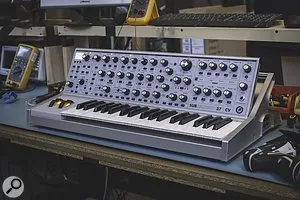
Additional product view and interface angle for Moogfest 2017.
Written by SM Mastering
Official content on sound engineering, mixing, mastering, and advanced electronic production by SM Mastering.