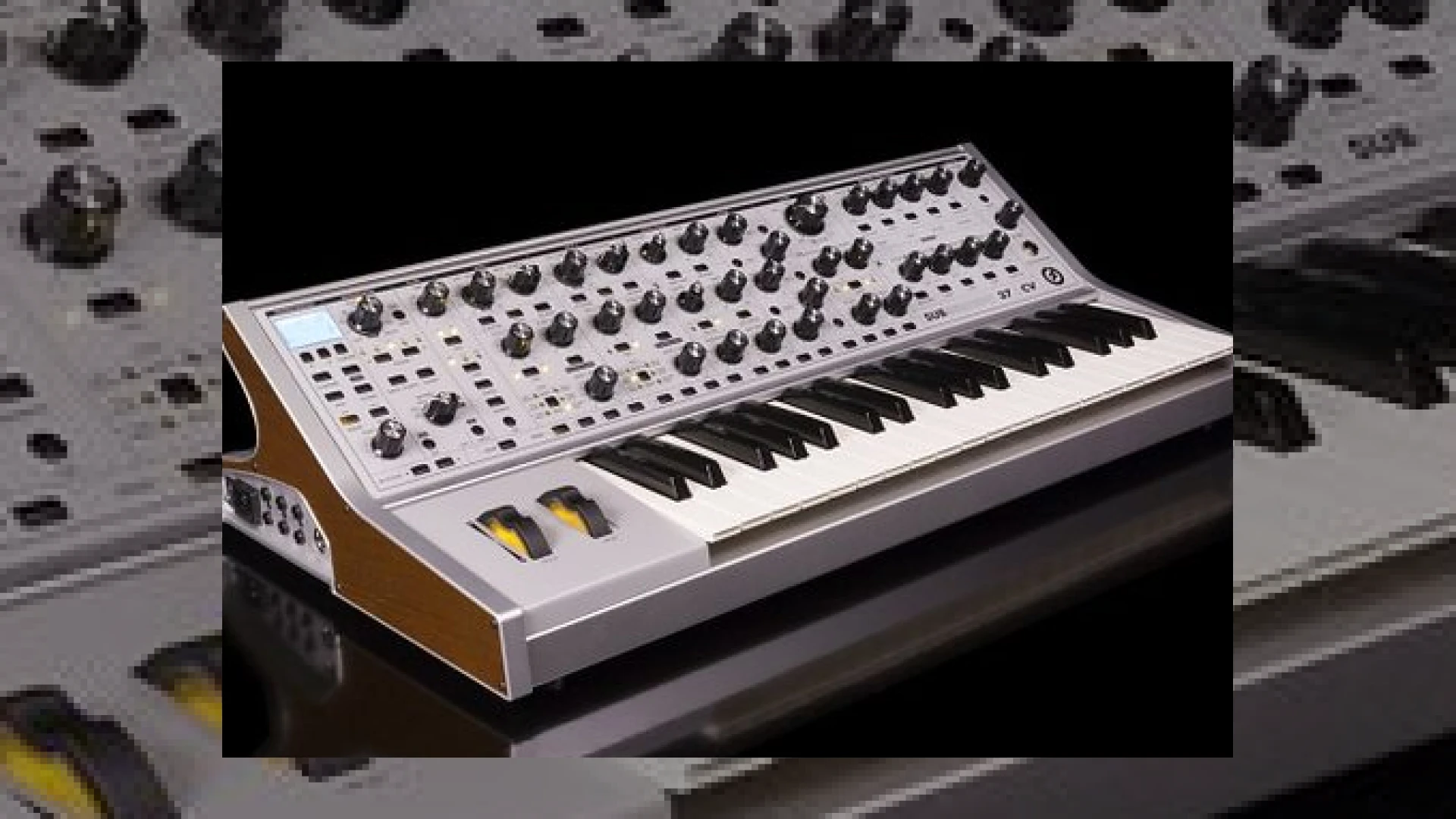
Visual context for Moog announce Subsequent 37 CV.
When the team at Moog announce Subsequent 37 CV, the entire analog synthesizer community sat up and took notice. As mastering engineers, we continuously analyze the transient response, harmonic footprint, and spectral weight of new hardware instruments. The Sub 37 Tribute Edition has long been a studio workhorse for heavy basslines and rich leads, but this newly announced limited-edition redesign elevates the platform into a highly versatile centerpiece for modern hybrid studios.
This release addresses one of the most requested features from modular synthesis enthusiasts: control voltage interconnectivity. By bridging the gap between Moog’s classic paraphonic voice architecture and external Eurorack setups, the Subsequent 37 CV becomes far more than just a standalone keyboard—it functions as an expressive controller and an analog processing hub. If you are looking to learn more about integrating hardware synthesizers into your final master, check out our expert guides at SM Mastering Audio Articles.
Technical Breakdown: Moog Announce Subsequent 37 CV
The primary engineering enhancement featured in the Subsequent 37 CV is the addition of four assignable CV outputs and two assignable Gate outputs. This configuration permits direct, seamless CV routing to Eurorack systems, large-format modular synthesizers, or CV-compatible effects units. Historically, integrating a keyboard synth into a complex modular patch required external MIDI-to-CV converters, which often added latency and jitter. This direct connection ensures exceptionally tight modulation tracking.
Beyond the control voltage upgrade, Moog’s Chief Engineer, Cyril Lance, revealed that the internal audio signal path has undergone significant reworking. To optimize sound quality, Moog increased the mixer headroom. This modification allows the synthesizer’s duophonic mode to sound cleaner and more defined, avoiding unwanted intermodulation distortion when playing two notes simultaneously. When we first saw Moog announce Subsequent 37 CV, we knew this increased headroom would also improve how the synth responds to high-end analog outboard gear, such as compression units from Universal Audio.
Additionally, the legendary Moog Ladder Filter has been modified to reshape the gain-staging, boosting harmonic saturation and analog compression. The multidrive circuit has also been retuned, offering a broader and more aggressive distortion range. Visually, the unit is striking, housed in a rugged steel and aluminum chassis with solid aluminum side panels inset with North American hardwood.
Subsequent 37 CV Specifications
For synthesists and studio producers tracking this release, here is a detailed breakdown of the technical specifications and pricing for the Subsequent 37 CV.
| Name | Use | Price | Rating |
|---|---|---|---|
| Moog Subsequent 37 CV | Paraphonic Analog Synthesizer & CV Controller | $1799 USD | 4.9 / 5.0 |
Practical Studio Workflow Tips
Integrating a powerful analog synthesizer like this into your production workflow requires a structured approach to maximize its sonic capability. Here are three practical tips to consider:
- Leverage the Expanded Headroom: Because of the re-engineered mixer section, you can drive the oscillators harder before hitting the filter. Keep the oscillator levels below 50% for pristine, smooth lead tones, or push them beyond 70% to introduce rich, musical odd-order harmonics before you even engage the Multidrive circuit.
- Modular Clock Synchronization: Use the assignable Gate outputs to send clock signals directly from the Subsequent 37 CV’s internal step sequencer to your modular sequencers or clock dividers. This keeps your entire hardware setup perfectly locked in phase without relying on DAW clocking.
- Dual-Mono Processing: Since the day we heard Moog announce Subsequent 37 CV, we have been testing various routing techniques. Try routing one of the CV outputs to control the cutoff frequency of an external analog filter module while processing the main synth output through a stereo chorus. This creates an incredibly wide and dynamic stereo image during the mixing stage.
Conclusion
The decisions that led Moog announce Subsequent 37 CV demonstrate a profound respect for their user base. By upgrading the keybed for enhanced playability, introducing a high-powered headphone amplifier, and adding premium CV connectivity, Moog has created a future classic. With a global production run limited to just 2000 units, it stands as a premium collector’s piece and an indispensable tool for serious sound designers.
Frequently Asked Questions
What is the difference between the Sub 37 and the Subsequent 37 CV?
The Subsequent 37 CV features four assignable CV outputs, two assignable Gate outputs, doubled mixer headroom, an upgraded keybed, a high-powered headphone amplifier, and a redesigned aesthetic featuring custom wood-and-aluminum side panels.
Can the Subsequent 37 CV be integrated into a DAW-based studio?
Yes. It features full MIDI-over-USB functionality alongside standard MIDI DIN I/O, allowing you to use it as a highly responsive MIDI controller while simultaneously routing CV to your analog modular hardware.
How limited is the production run of the Subsequent 37 CV?
Moog has announced that only 2000 units of the Subsequent 37 CV will be produced worldwide, with the first 125 units sold exclusively through Guitar Center and the Moog Pop-Up Factory during Moogfest.
🛒 Official Product Info & Where to Buy
Check full technical specs, pricing, and purchase options directly from the official manufacturer or authorized dealer for Moog announce Subsequent 37 CV.

Written by SM Mastering
Official content on sound engineering, mixing, mastering, and advanced electronic production by SM Mastering.