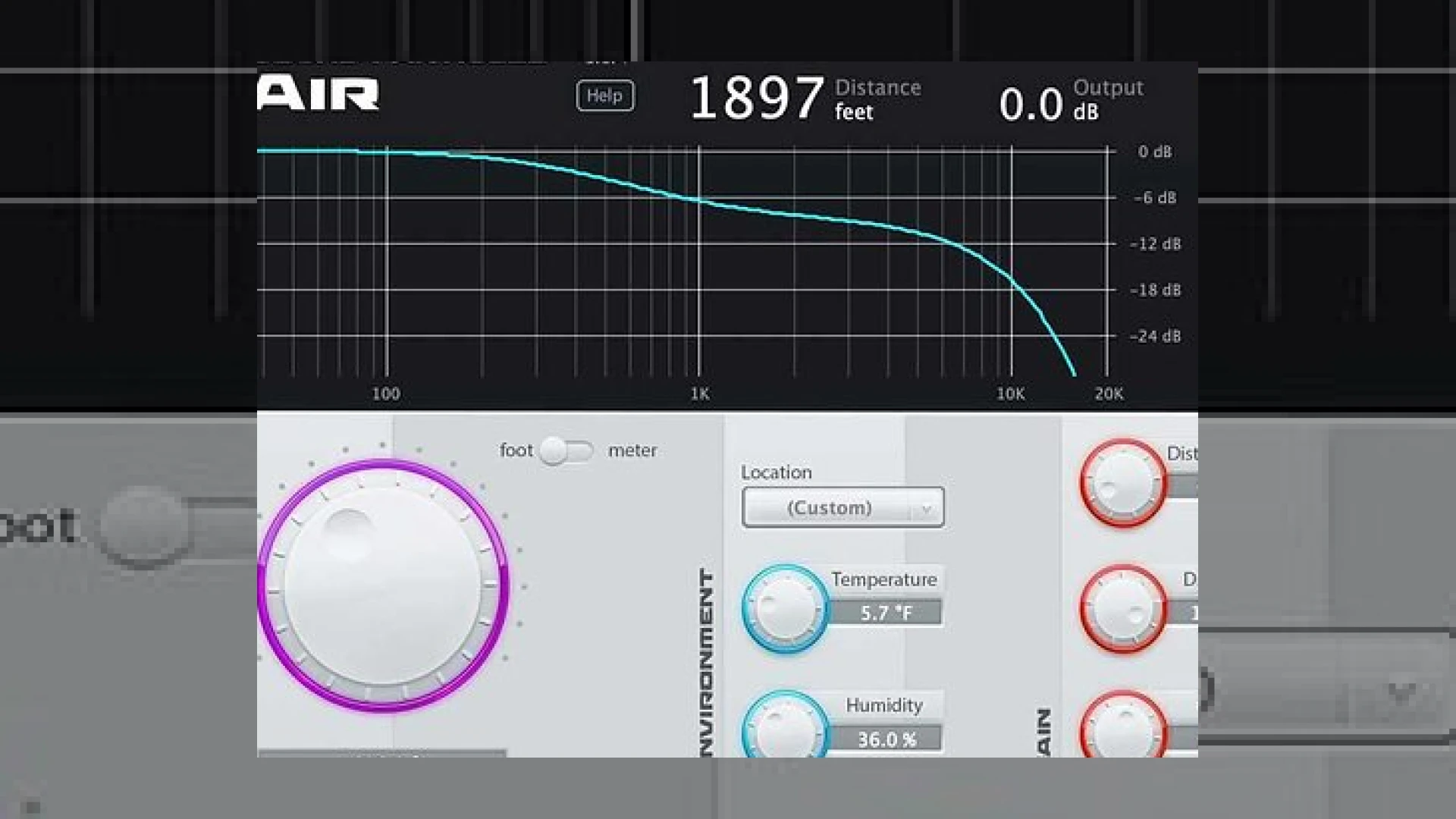
Visual context for Sound Particles release Air plug-in.
In the realm of professional audio mixing and mastering, achieving a realistic sense of depth and physical distance has always been a challenging task. While standard tools like high-shelving filters and low-pass EQs have historically been the go-to solutions for rolling off top-end frequencies, they often fail to capture the complex natural characteristics of sound traveling through physical space. An exciting development has reached the audio community as we watch the sound particles release air plug-in, a dedicated tool designed to simulate airborne high-frequency loss with scientific accuracy.
The physics of sound propagation dictate that as acoustic waves travel through the air, high frequencies are absorbed much more rapidly than low frequencies. This attenuation is not uniform; it varies wildly based on ambient environmental conditions. Whether you are mixing ADR for a feature film or trying to place a synth pad deep in a stereo field, the sound particles release air plug-in offers a fast, mathematically precise solution that bypasses the guesswork of manual EQ adjustments. According to industry analyses hosted on SM Mastering Audio Articles, having specialized physical modeling tools dramatically speeds up the spatial placement of sound sources in both stereo and immersive formats.
How the sound particles release air plug-in Simulates Distance
What sets this processor apart from traditional equalization tools is its control scheme. Instead of prompting the user to adjust frequency bands and decibel cuts, this plugin relies on physical parameters. Users simply input the target distance, temperature, and relative humidity of the environment they wish to replicate. The underlying engine then calculates the exact atmospheric absorption coefficients to apply to the audio signal.
Historically, this process was bundled within their Doppler tool, but this dedicated sound particles release air plug-in allows static audio sources to benefit from realistic spatialization. To make things even easier for fast-paced post-production environments, Sound Particles has included a series of highly practical location-based presets. These presets, such as “Death Valley in Summer” or “New York in Autumn,” allow mixers to instantly simulate different climates and geographic conditions without needing a degree in acoustic physics.
While industry-leading restoration suites from manufacturers like iZotope focus on spectral shaping and repair, the sound particles release air plug-in targets atmospheric air absorption based on real-world physics. This makes it an invaluable asset for dialogue editors, sound designers, and mixing engineers alike.
Technical Specifications and Overview
To help you understand where this processor fits in your production budget and toolkit, we have compiled its key specifications below:
| Name | Primary Use | Price | Rating |
|---|---|---|---|
| Sound Particles Air | Acoustic distance and high-frequency air absorption simulation | $55 | 4.8 / 5.0 |
Practical Studio Workflow Tips
Integrating a specialized tool like this into your workflow can yield incredible spatial realism. Here are a few practical tips on how to maximize its potential in your sessions:
- Precise ADR Matching: When matching clean studio-recorded dialogue (ADR) to production audio captured on location, set the temperature and humidity to match the day of the shoot. This aligns the high-frequency roll-off perfectly with the original environment.
- Creating Depth Layering in Music: In stereo music mixes, insert the plugin on background elements like backing vocals, acoustic guitars, or ambient synths. By setting a virtual distance of 10 to 15 meters, you can push these elements behind the lead vocal without cluttering your mix with standard EQ cuts.
- Automating Movement: Even though this is a static processor, automating the distance parameter can create a realistic “moving away” effect that feels far more natural than a simple volume or low-pass filter sweep.
Conclusion
Ultimately, this sound particles release air plug-in is an indispensable asset for any modern studio looking to elevate their spatial mixing capabilities. By shifting the focus from abstract frequency values to tangible physical metrics like distance, temperature, and humidity, Sound Particles has simplified a highly technical acoustic phenomenon into an intuitive, creative tool. For just $55, it provides an unparalleled level of realism that standard EQs simply cannot reproduce.
Frequently Asked Questions (FAQ)
How does the Sound Particles Air plug-in differ from a standard EQ?
Unlike a standard EQ where you manually set cutoff frequencies and slopes, the Air plug-in uses physical modeling. It calculates high-frequency loss based on real-world physics, taking distance, temperature, and humidity into account to create a natural acoustic roll-off.
Can I use this plug-in for music production as well as post-production?
Absolutely. While it is heavily marketed toward post-production and ADR matching, it is an excellent tool for music producers who want to create a true sense of depth and front-to-back perspective in their stereo or Dolby Atmos mixes.
What physical parameters can I control inside the plug-in?
The plug-in allows you to control the virtual distance between the sound source and the listener, the ambient air temperature, and the relative humidity of the environment, alongside various pre-configured geographical presets.
🛒 Official Product Info & Where to Buy
Check full technical specs, pricing, and purchase options directly from the official manufacturer or authorized dealer for Sound Particles release Air plug-in.

Written by SM Mastering
Official content on sound engineering, mixing, mastering, and advanced electronic production by SM Mastering.