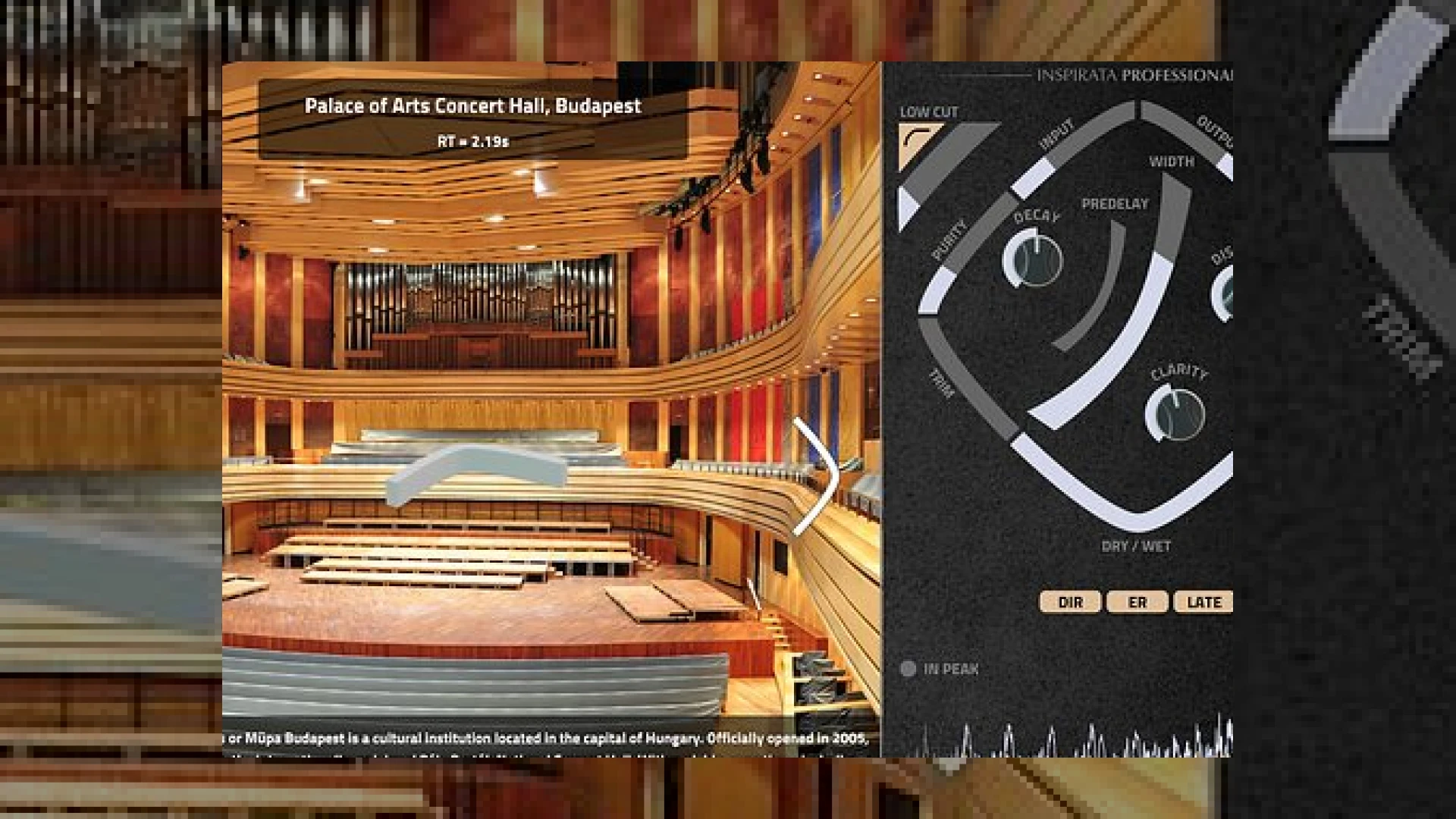
Visual context for Inspired Acoustics release Inspirata.
The professional audio production landscape has just witnessed a groundbreaking development in spatial acoustics. With the official **inspired acoustics release inspirata**, mixing and mastering engineers are being introduced to a new paradigm of spatial processing. Traditionally, reverb design has been split down the middle: you either choose the pristine realism of static convolution impulse responses or the dynamic flexibility of algorithmic reverbs. Inspired Acoustics, highly regarded for their ultra-realistic pipe organ samples, have bridged this historical gap with a revolutionary concept called “computational reverb.”
Understanding the Architecture of Computational Reverb
Unlike standard convolution processors that load a single static impulse response (IR), the computational engine driving Inspirata utilizes a highly detailed, multi-dimensional representation of physical spaces. The acoustic consultants behind this plugin spent years capturing thousands of precise source and listener positions within world-class halls, churches, and studios. This massive spatial database allows the software to calculate physical wave propagation in real-time. Mixing engineers can physically position sound sources within a virtual room and automate their movement smoothly, without any of the digital artifacts, clicks, or pitch-shifting glitches traditionally associated with changing IRs on the fly.
How the Inspired Acoustics Release Inspirata Redefines Spatial Audio
For mastering houses and high-end post-production studios, tools from industry giants like iZotope and Universal Audio have long set the bar for spatial clarity and spectral balance. However, the **inspired acoustics release inspirata** introduces an unprecedented level of acoustic simulation. By allowing multi-source configurations within a single instance, the plugin acts more like a virtual mixing stage than a simple insert effect. You can route multiple independent inputs to distinct physical coordinates within the same room, outputting directly to complex surround-sound arrays.
Since the **inspired acoustics release inspirata**, our engineers have been testing its capabilities across various acoustic environments. To understand how spatial depth and acoustic reflections influence the final master, feel free to explore our comprehensive guides on the SM Mastering Audio Articles platform.
Technical Specifications
Inspirata is distributed in several editions, ranging from a stereo-only version up to the flagship edition designed for immersive, multi-channel surround sound configurations.
| Name | Primary Use | Price Tier | Rating |
|---|---|---|---|
| Inspirata Personal | Stereo production & project studios | $199 (approx.) | 4.2 / 5 |
| Inspirata Professional | Pro stereo & surround setups (up to 7.1.2) | $599 (approx.) | 4.7 / 5 |
| Inspirata Immersive | High-end dubbing, Atmos & 22.2 surround | $1199 (approx.) | 4.9 / 5 |
Practical Studio Workflow Tips
- Automating Soundstages: Use host automation to dynamically move a dry source, such as a solo violin, from the back of the hall to the front stage during dynamic transitions. Because of the computational engine, the change in early reflections occurs naturally without phase cancellation.
- Managing Resource Allocation: Instantaneous room switching is highly optimized in Inspirata. If your CPU load is peaking near its limit, keep the room model constant and automate the “Width” and “Clarity” parameters rather than loading multiple instances of the plugin.
- Optimizing the Master Bus: When mastering acoustic projects, apply a subtle touch of a medium-sized hall from Inspirata on a parallel auxiliary track. Send no more than 5-10% of the signal to glue independent elements together into a cohesive, realistic acoustic field.
Conclusion
Ultimately, the **inspired acoustics release inspirata** is a landmark achievement in spatial DSP technology. By combining the physical authenticity of real-world acoustic measurements with the flexibility of a dynamic algorithmic engine, it sets a new benchmark for how engineers interact with space in a digital workstation. Whether you are mixing stereo acoustic jazz or panning complex arrangements for 22.2 immersive cinema, Inspirata delivers an unparalleled degree of acoustic reality.
Frequently Asked Questions
What is computational reverb?
Computational reverb is a hybrid processing method that uses extensive physical measurements of real spaces to reconstruct a dynamic acoustic model. Unlike static convolution, it allows users to move sources and listeners in real-time without introducing audible glitches.
What surround sound formats does Inspirata support?
Depending on the edition chosen, Inspirata supports formats ranging from standard stereo up to 22.2-channel immersive surround sound layouts, making it highly suitable for Dolby Atmos and film post-production.
Can I automate the position of multiple instruments independently?
Yes. Inspirata allows you to treat multiple inputs as separate sound sources, giving you the ability to position and automate each instrument’s physical location within the chosen room independently.
🛒 Official Product Info & Where to Buy
Check full technical specs, pricing, and purchase options directly from the official manufacturer or authorized dealer for Inspired Acoustics release Inspirata.

Written by SM Mastering
Official content on sound engineering, mixing, mastering, and advanced electronic production by SM Mastering.