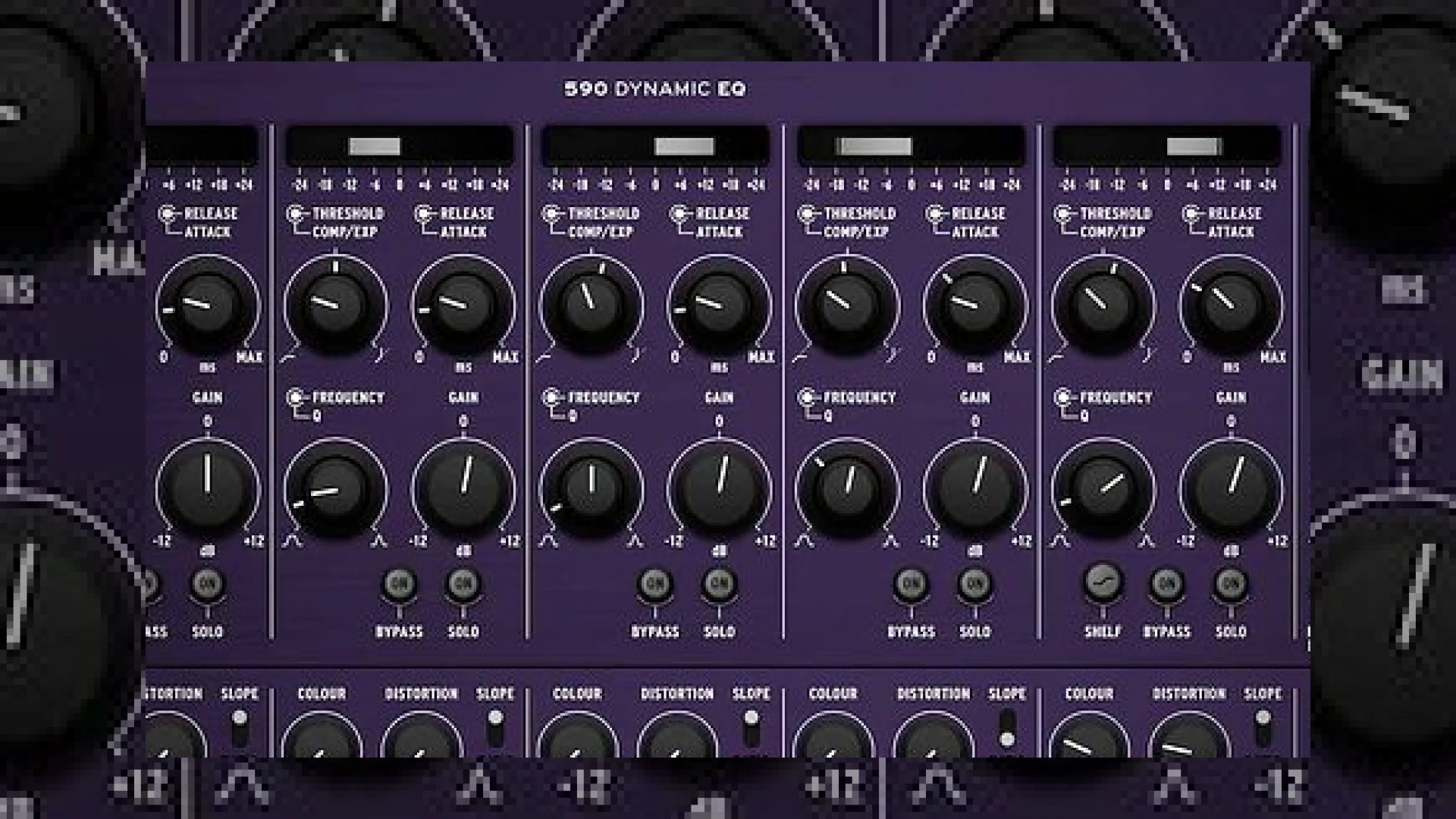
Visual context for MIA Laboratories 590 Dynamic EQ plug-in.
Modern mixing and mastering workflows demand surgical precision coupled with musical analog warmth. At SM Mastering, we constantly evaluate cutting-edge processors to elevate our signal chains, and few processors bridge the gap between digital accuracy and analog character quite as effectively as the mia laboratories 590 dynamic eq plug-in. Whether you are taming unruly resonances in a dense mix or breathing life into a master bus, advanced dynamic equalization has become an indispensable tool for professional audio engineers.
Exploring the Architecture of the mia laboratories 590 dynamic eq plug-in
The mia laboratories 590 dynamic eq plug-in couples a powerful five-band dynamic equalizer with dual-mode analog saturation. Each of the five bands can operate in either compression or expansion modes, driven by the custom envelope detector derived from the company’s celebrated 925 and 409 compressors. This ensures ultra-smooth transient handling with attack times up to 200 ms and release times reaching 2000 ms.
Bands one and five feature switchable low- and high-shelf options, while all bands offer peak filtering with a gain range of -12 to +12 dB alongside variable Q controls. Engineers looking for inspiration can reference industry standards like those discussed on the Universal Audio blog to understand how dynamic processing shapes modern mixes. Furthermore, slope and ratio modes allow users to dial in either subtle transparency or aggressive, character-heavy dynamic control.
Advanced Tone Shaping and Saturation
What truly sets the mia laboratories 590 dynamic eq plug-in apart from traditional static and dynamic EQs is its per-band analog emulation circuitry. Each band features a dedicated Colour knob powered by the Musiqual EQ Series. Bands 1 and 2 utilize Musiqual Red to emulate valve preamp warmth, while bands 3 through 5 utilize Musiqual Blue, inspired by vintage Class-A architectures. Combined with a dedicated Distortion knob mimicking triode valve amplification, this processor allows you to sculpt frequencies and enrich harmonics simultaneously.
Practical Studio Workflow Tips
- Vocal De-Harshness: Insert the mia laboratories 590 dynamic eq plug-in on lead vocal buses. Set a band around 2.5 kHz to 4 kHz in compression mode with a fast attack to gently suppress harsh sibilance only when it pierces the mix.
- Gaining deep insights into advanced processing techniques is easy when you check out our professional resources at SM Mastering Audio Articles for more expert guidance.
- Low-End Management: Utilize the global high-pass filter alongside band one in expansion mode to tighten up the sub-bass of a full mix without sacrificing punch.
- Instrument Saturation: Push the Musiqual Red colour circuit on rhythm guitars or synths to add analog weight and harmonic density before sending them to a limiter.
Technical Specifications
| Parameter | Specification Details |
|---|---|
| Name | MIA Laboratories 590 Dynamic EQ |
| Use | Dynamic Equalization, Frequency-Dependent Saturation, Mastering & Mixing |
| Price | Standard Manufacturer Retail Pricing |
| Rating | 4.8 / 5.0 (SM Mastering Certified) |
Conclusion
The mia laboratories 590 dynamic eq plug-in is a stellar addition to any mixing or mastering engineer’s toolkit. By merging transparent, flexible multi-band dynamic control with rich, musical valve and Class-A saturation models, it offers creative problem-solving capabilities that go far beyond standard digital EQs. Highly recommended for professionals seeking both surgical precision and analog warmth.
Frequently Asked Questions
What is the mia laboratories 590 dynamic eq plug-in best used for?
It is exceptionally well-suited for transparently controlling troublesome dynamic resonances, shaping tone on complex buses, and introducing musical analog saturation to individual frequency bands during mixing and mastering.
Does the 590 Dynamic EQ include saturation features?
Yes, every band features independent Colour controls based on the Musiqual EQ series (emulating valve and Class-A preamps) alongside a dedicated distortion control that models triode valve amplification.
Can the dynamic bands act as both compressors and expanders?
Yes, all five bands can operate in either compression or expansion modes, allowing you to either suppress peaks or amplify transient details dynamically based on your source material.
🛒 Official Product Info & Where to Buy
Check full technical specs, pricing, and purchase options directly from the official manufacturer or authorized dealer for MIA Laboratories 590 Dynamic EQ plug-in.

Written by SM Mastering
Official content on sound engineering, mixing, mastering, and advanced electronic production by SM Mastering.