FREE Vst Plugin Analog Channel
Table of Contents – FREE Vst Plugin Analog Channel
FREE Vst Plugin Analog Channel Architecture and Impact of KuramaSound AnalogChannel: A Technical Analysis of Open-Source Signal Processing in the Professional Mixing Workflow
The evolution of digital audio processing (DSP) has reached a stage of maturity where the distinction between high-cost proprietary tools and open-source solutions has become increasingly thin. The release of AnalogChannel by KuramaSound on December 24, 2025, marks a milestone in this process, representing a sophisticated synthesis of elite algorithms previously scattered across fragmented ecosystems. Developed by Filippo Terenzi, an engineer and producer based in Modena, Italy, the plugin is not merely an isolated processor but a framework that encapsulates decades of DSP innovation, specifically porting renowned algorithms from developer Chris Johnson (Airwindows) and classic JSFX processors from the Reaper community. This report exhaustively analyzes the architecture, sonic mechanics, and market implications of AnalogChannel within the context of modern music production.
Technical Genesis and the Philosophy of DSP Curation
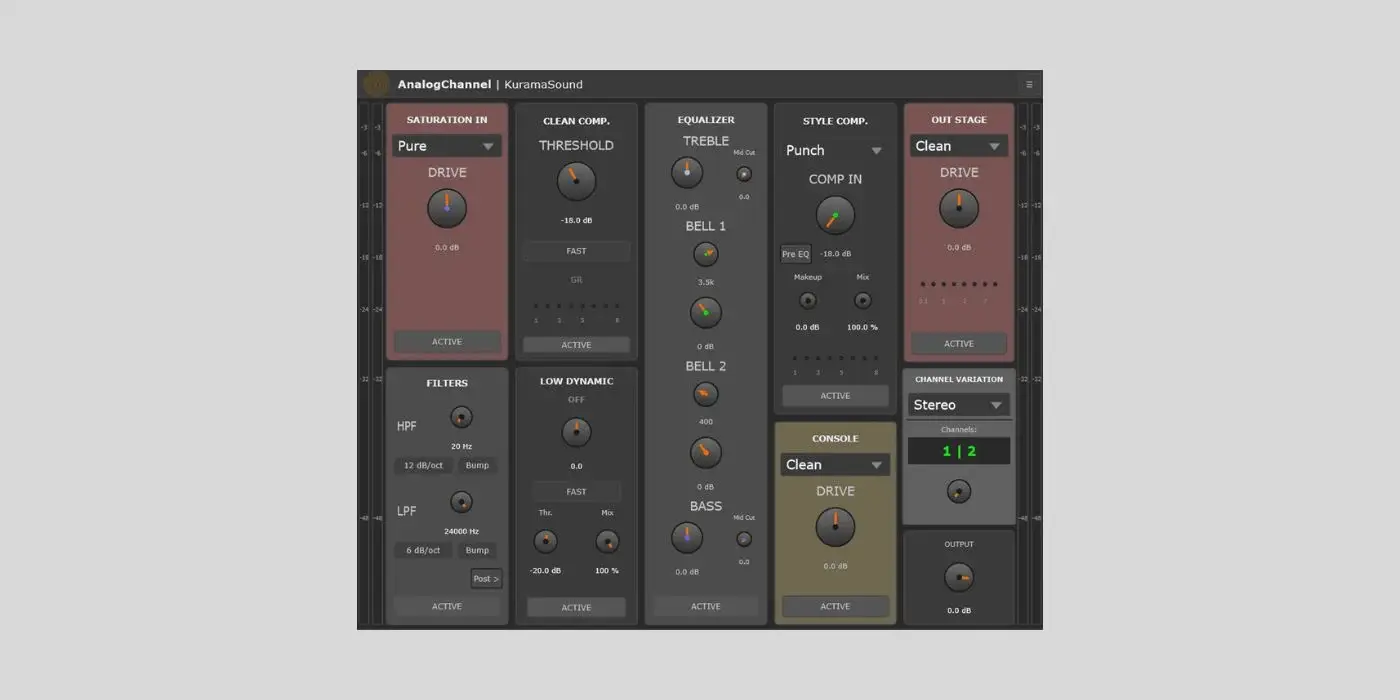
Historically, utilizing open-source algorithms like those from Airwindows faced a significant barrier: the user interface. While the sonic quality of Chris Johnson’s algorithms is widely recognized as mastering-grade, the absence of proprietary graphical user interfaces (GUIs) forced users to interact with generic controls provided by the Digital Audio Workstation (DAW), which often hindered fast and intuitive decision-making. AnalogChannel resolves this friction by acting as a curated “wrapper,” organizing these algorithms into a logical and traditional analog console signal chain.
KuramaSound’s approach prioritizes workflow efficiency without sacrificing harmonic complexity. By pre-configuring dynamic parameters and discrete frequency selections, the plugin removes the choice paralysis that often accompanies contemporary digital tools, allowing the mixing engineer to make decisions based on musicality rather than surgical precision. This design philosophy is grounded in a dual-mono architecture, essential for replicating the subtle phase and amplitude variations that define physical hardware.
| Processing Stage | Primary DSP Origin | Core Signal Function |
| Input Saturation | Airwindows Ports | Initial harmonic generation and gain |
| HPF/LPF Filters | JSFX/Custom | Spectral cleaning with resonance (Bump) |
| “Clean” Compressor | Open Source DSP | Transparent peak management |
| Low Dynamic | Custom Design | Downward expansion or upward compression |
| 4-Band EQ | Baxandall/Custom | Musical tonal shaping with dynamic Q |
| Style Compressor | Character Models | Optical (Warm) and Transient (Punch) modes |
| Console Emulation | Airwindows Console7 | Harmonic glue and simulated crosstalk |
| Output Stage | Airwindows Saturation | Final conditioning and clipping (Soft/Hard) |
In-Depth Analysis of Signal Chain and Harmonic Mechanics
The heart of AnalogChannel lies in its ability to introduce non-linear saturation in a controlled and musical way. The input stage offers four distinct modes that define the tonal foundation of the track. “Clean” mode operates as a linear digital gain stage, while “Pure” mode introduces transparent saturation that preserves transient integrity. The true differentiation occurs in “Tape” and “Tube” modes. Tape mode emulates the physical characteristics of reel-to-reel machines, incorporating nuances like “head bump” (low-frequency resonance) and subtle flutter fluctuations. Tube mode utilizes a three-stage asymmetric harmonic structure designed to mimic the thermal distortion of vacuum tubes, resulting in a perception of “warmth” and depth.
Low Dynamic and Upward Compression
One of the most innovative features of AnalogChannel is the “Low Dynamic” section, a single-knob processor that acts on signals below a defined threshold. Unlike traditional (downward) compression, which acts by reducing the highest peaks, this section allows for upward compression, which raises the subtlest audio details without compromising the initial impact of transients.1 This method is fundamental in modern mixing to bring out room ambience, instrument sustain, and vocal details that would otherwise be lost in a dense mix.1
Additionally, the module alternatively functions as a downward expander/gate, allowing for noise control and cleaning bleed in drum recordings. Integrating this functionality into a single channel strip simplifies processes that would normally require multiple plugins or complex parallel compression routing.
Style Compression Strategies
Compression in AnalogChannel is divided between a utility phase (“Clean”) and a character phase (“Style”). The Style compressor offers two operation modes that are fundamental to the plugin’s aesthetic:
- Warm Mode: Inspired by classic optical compressors like the Tube-Tech CL1B, this mode features adaptive and musical attack and release times. It is ideal for “gluing” vocals or bass, adding an organic vibe and smoothing peaks imperceptibly.
- Punch Mode: Focused on transient enhancement, this mode is designed for percussive elements. It acts similarly to a transient shaper, ensuring that the initial attack of a kick or snare cuts through the mix with authority.
The ability to switch between these two compression philosophies within the same plugin offers significant versatility, allowing the engineer to adapt processing to the rhythmic or melodic function of the track.
Spectral Sculpting: Baxandall EQ and Dynamic Q
The equalization section of AnalogChannel moves away from the surgical approach common in modern digital EQs, opting for musical Baxandall curves in its low and high shelves. The Baxandall design is valued for its smooth and natural transition between frequencies, allowing for substantial boosts without introducing aggressive phase artifacts or a sense of “harshness” in the high end.
A critical refinement introduced by Terenzi is the inclusion of a “Mid-Cut” control integrated into the Baxandall shelves. This allows the user to remove “boxiness” (typically between 300Hz and 500Hz) simultaneously with high/low end boosting—a standard “clean and polish” technique used in professional mixing.
The central parametric bands utilize a “Dynamic Q” system, similar to the proportional equalization found in classic API consoles. In this system, the bandwidth (Q) narrows as gain is increased. Subtle adjustments result in wide, gentle curves, while extreme adjustments make the curve sharper and more focused, allowing the tool to behave intuitively based on mix requirements.
| EQ Section | Filter Type | Q Behavior | Recommended Application |
| Low Shelf | Baxandall | Fixed/Smooth | Weight and sub-bass foundation |
| Low Mid | Parametric | Proportional (Dynamic) | Controlling resonance and body |
| High Mid | Parametric | Proportional (Dynamic) | Vocal presence and string attack |
| High Shelf | Baxandall | Fixed/Smooth | Air, shimmer, and general clarity |
Console Emulation and Channel Variation System
AnalogChannel incorporates a console emulation stage that allows the user to choose between three iconic sounds: Essex, Oxford, and USA. These names are direct references to the console architectures that shaped recorded music history: Neve, SSL, and API, respectively.
The processing for these emulations is derived from the Airwindows Console7 system, which stands out for not being just a static saturator. Console7 emulates the summing interaction and crosstalk that occurs in a real analog console. In AnalogChannel, this stage serves to “glue” the mix together, introducing subtle imperfections that help sterile digital instruments sound more cohesive and three-dimensional.
To reinforce this authenticity, the plugin features the “Channel Variation System,” offering 48 unique channel presets. This system emulates the tolerances of individual electronic components in a physical console, where every tape channel or desk strip has a slightly different phase and frequency response. By applying different variations across different tracks, the engineer can simulate the cumulative effect of a mix done on a large-format console, avoiding the “flatness” often associated with perfect digital summing.
Technical Performance: Sample Rates and Slew Clipping
A major technical challenge in modern DSP is the treatment of transients at high sample rates. AnalogChannel integrates the “slew clipping” corrections introduced in Airwindows Channel7. Slew rate refers to the maximum speed at which a circuit can change its output voltage. In the digital domain, aggressive saturation algorithms can cause unwanted distortion and sonic “artifacts” if slew rate is not managed correctly, especially at 96kHz or 192kHz.
AnalogChannel uses an approach that transitions smoothly between “Spiral” and “Density” algorithms. The Spiral algorithm focuses on the purity and clarity of harmonic distortion, while Density focuses on weight and thickness. The implementation of Channel7 allows the drive to move continuously between these two models, ensuring the sound remains “fat” and musical regardless of saturation load or project sample rate.
Furthermore, all internal processing occurs on a dithered 32-bit floating-point bus. This technique, pioneered by Airwindows, ensures that every processing stage preserves maximum resolution and that quantization errors are treated musically, preventing the accumulation of low-fidelity digital noise.
Comparative Market Analysis: The Value of Open Source
In the 2024-2025 market, AnalogChannel competes with established giants. However, its free and open-source nature under the GPL 3 license uniquely positions it for producers seeking professional-grade tools without subscription restrictions or hardware dongles.
| Developer | Product | Pricing Structure | Key Strength |
| KuramaSound | AnalogChannel | Free (GPL 3) | Curated Airwindows flow, Zero latency |
| Universal Audio | Century Tube Strip | Paid / UAD Spark | Polished interface, Low CPU (DSP) |
| Waves | Scheps Omni Strip | Paid | Extreme versatility, Dual de-essers |
| Kush Audio | UBK-2 / Blyss | Paid / Subscription | Unique analog tonality, Dynamic grooves |
| Brainworx | bx_console Series | Paid / PA | TMT technology (72 modeled channels) |
While paid plugins like Brainworx bx_console offer TMT (Tolerance Modeling Technology) with 72 channels, AnalogChannel provides 48 variations for free, covering a similar need for “analog imperfection” at zero cost. Compared to the Waves Scheps Omni, which is deliberately transparent until color is added, AnalogChannel is inherently focused on coloration, making it a faster choice for engineers seeking immediate “character.”
Practical Applications and Studio Workflow
AnalogChannel is optimized for fast mixing decisions. Its deliberate limitations—such as fixed attack times in the Style compressor—are actually tools to prevent decision fatigue. In a professional mixing scenario, the plugin can be used in the following ways:
- Character Vocal Chain: Using Tube mode on input for even harmonics, followed by the Style compressor in Warm (Optical) mode and the Baxandall EQ to add “air” to the highs. Mid-Cut can be used to clean up muddy resonances common in mid-tier microphones.
- Drum Processing: Tape mode on input helps “tame” cymbal peaks and add punch to the kick. Style compressor in Punch mode ensures the snare maintains its impact, while filters with the “Bump” option reinforce drum fundamentals.
- Mix Bus and Glue: Applying channel variation and console emulation (Essex/Neve for warmth or Oxford/SSL for modern brightness), the plugin can be inserted on the master bus to provide final cohesion, acting as a pre-mastering stage.
The zero-latency architecture makes AnalogChannel ideal not only for mixing but also for real-time monitoring during tracking, allowing musicians to hear a “finished” sound while performing.
Conclusions and Future Outlook
KuramaSound AnalogChannel represents a significant achievement in the democratization of high-fidelity audio tools. By unifying powerful Airwindows algorithms and JSFX flexibility into a VST3 interface for Windows and macOS, Terenzi has filled a critical gap for producers operating outside of closed proprietary ecosystems.
The dual-mono architecture, 32-bit dither system, and phase-coherent console emulations elevate this plugin from simple “freeware” to a commercial-grade studio processor. While the visual interface may evolve in future versions to offer a more tactile experience, the sonic integrity of AnalogChannel already places it among the best channel strips available in 2025.
Download: AnalogChannel
Find My Labels | findmylabels.com | SM Mastering – Mix & Master Services