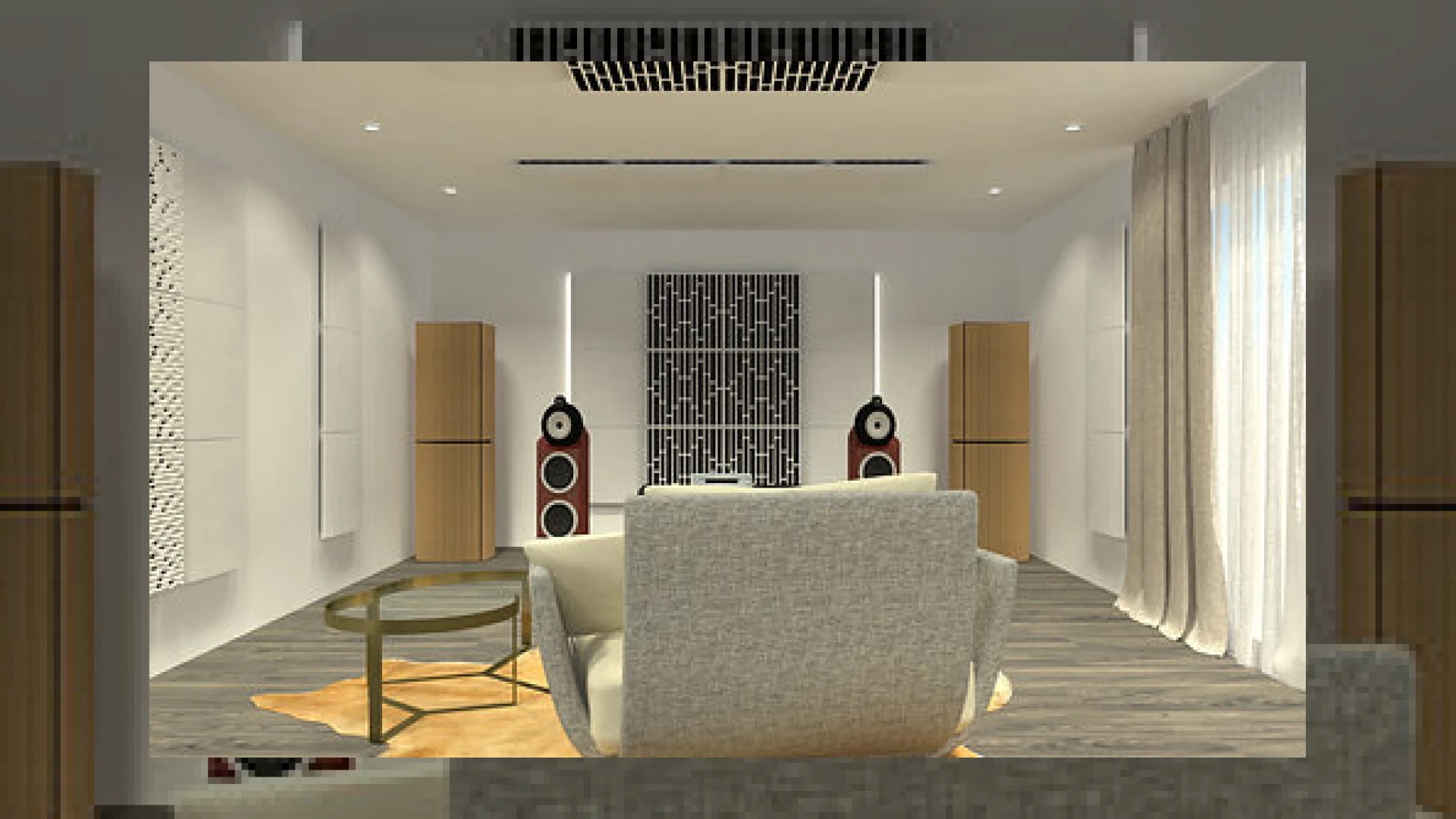
Visual context for Artnovion's Corner and Bass Traps feature TPDA tech.
At SM Mastering, we understand that managing low-end frequencies is one of the most challenging aspects of studio design. This is why we are closely examining how Artnovion’s Corner and Bass Traps feature TPDA tech to revolutionize modern acoustic treatment. Standing waves and modal resonances are notorious for ruining the translation of a master, making the corner regions of a room a critical battleground for sonic accuracy.
When evaluating professional studio acoustics, we often find that traditional porous absorbers fail to address deep sub-bass frequencies without occupying vast amounts of space. It is fascinating to see how Artnovion’s Corner and Bass Traps feature TPDA tech to combat this exact limitation. By utilizing a cutting-edge diaphragm design, these traps bypass the physical constraints of traditional acoustic foam and fiberglass treatments.
Understanding Tuned Pistonic Diaphragm Absorption
To understand why this is a game-changer, we must look at the mechanics of Tuned Pistonic Diaphragm Absorption (TPDA). Acoustic engineers are praising this innovation because Artnovion’s Corner and Bass Traps feature TPDA tech that delivers massive low-end absorption down to 40Hz within a highly compact footprint. This design works by incorporating a calibrated mass suspended on a highly elastic membrane, acting as a piston resonator that targets specific frequency bands with extreme precision.
For project studios and mastering suites alike, space is premium currency. Implementing these treatments shows that Artnovion’s Corner and Bass Traps feature TPDA tech to bypass the need for feet of bulky fiberglass, saving room while drastically tightening the stereo image. The efficiency of a TPDA-equipped panel is typically matched only by using up to two meters of traditional porous material, which is simply unfeasible for most working environments.
How Artnovion’s Corner and Bass Traps Feature TPDA Tech
By focusing on pressure-based absorption rather than velocity-based absorption, these units perform at their absolute peak in high-pressure zones like room corners. If you are aiming for pristine translation across various playback devices, proper low-frequency management is essential. Ultimately, if you are looking to upgrade your monitoring environment, understanding how Artnovion’s Corner and Bass Traps feature TPDA tech will help you make an informed decision on controlling pesky standing waves.
For more insights on upgrading your monitoring path, high-end audio interfaces, and digital signal processors, check out the SM Mastering Audio Articles database.
Acoustic Specifications Comparison
| Name | Primary Use | Price Range | Rating |
|---|---|---|---|
| Artnovion Sub-Trap (TPDA) | Ultra-low sub-bass absorption (down to 40Hz) | Premium / Subject to Quote | 5 / 5 |
| Artnovion Corner Bass Trap | Low-to-mid frequency control & modal correction | Premium / Subject to Quote | 4.8 / 5 |
| Standard 100mm Fiberglass Panel | Broadband mid-high absorption only | Budget-friendly | 3 / 5 |
Practical Studio Workflow Tips for Low-End Treatment
- Identify Your Modes: Before installing any panels, use a calibration microphone and measurement software to find the exact frequency of your room’s standing waves.
- Target High-Pressure Zones: Place TPDA traps in tri-corners (where two walls meet the ceiling or floor) for maximum low-frequency absorption.
- Combine with Quality Equipment: To hear the full benefits of a treated room, use top-tier converters and monitoring controllers, such as those from Universal Audio, to ensure your source audio is completely transparent.
- Fine-Tune Your Subwoofers: If you use subwoofers, align their phase and crossover points to match the acoustic decay times corrected by your TPDA traps.
Conclusion
Artnovion has set a new standard in compact low-frequency acoustic treatment. By moving away from bulky, inefficient materials and embracing advanced mechanical physics, they have allowed smaller studios to achieve mastering-grade acoustics. Integrating these traps into your space will pave the way for faster mix decisions, accurate low-end translation, and a much more enjoyable production workflow.
Frequently Asked Questions
What is the benefit of TPDA technology over standard foam bass traps?
TPDA technology utilizes a calibrated mass suspended on an elastic membrane, working as a pressure-based piston. This allows it to absorb extremely low frequencies (down to 40Hz) in a highly compact design, whereas standard foam traps rely on velocity-based absorption and require massive depth to be effective at low frequencies.
Can Artnovion’s Sub-Traps be tuned to specific frequencies?
Yes, Artnovion’s Sub-Traps featuring TPDA technology can be physically tuned to target specific low-frequency modal resonances in your room, ensuring precise acoustic correction without over-damping high frequencies.
Are these acoustic treatments suitable for home mastering studios?
Absolutely. Because home mastering studios are often limited by physical space, these high-efficiency, small-footprint traps are ideal for correcting severe low-frequency acoustic problems without sacrificing valuable floor space.
🛒 Official Product Info & Where to Buy
Check full technical specs, pricing, and purchase options directly from the official manufacturer or authorized dealer for Artnovion's Corner and Bass Traps feature TPDA tech.

Written by SM Mastering
Official content on sound engineering, mixing, mastering, and advanced electronic production by SM Mastering.