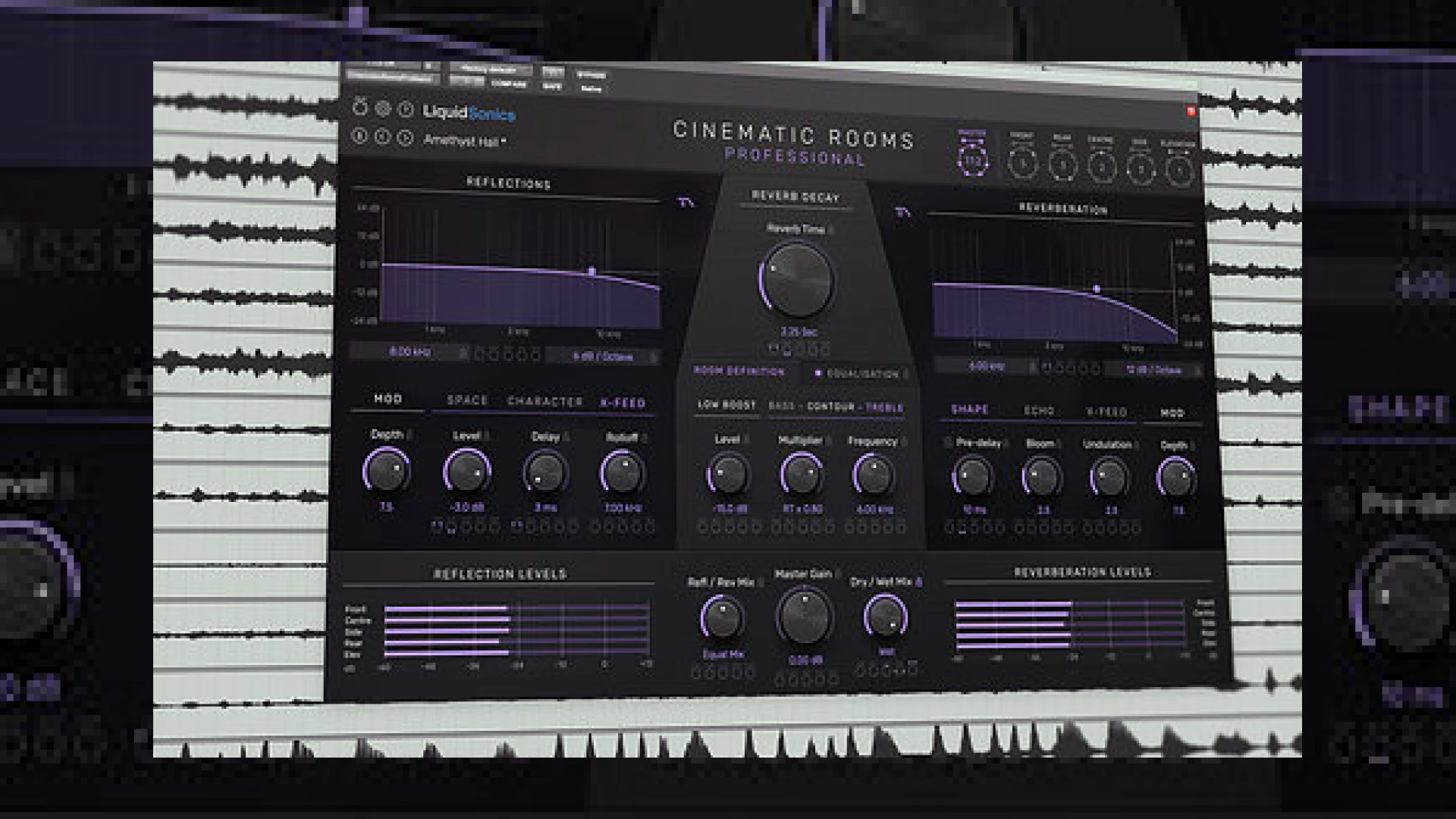
Visual context for LiquidSonics launch Cinematic Rooms.
The professional audio production industry has reached an exciting milestone as reverb innovators LiquidSonics have officially unveiled their latest masterpiece. When the news broke regarding the liquidsonics launch cinematic rooms, spatial audio mixers and mastering engineers worldwide took immediate notice. Known for their world-class hardware emulation and convolution technologies, the London-based developer has taken a bold step forward by offering a dedicated, all-algorithmic spatial reverb tailored specifically for complex multi-channel formats and demanding modern workflows.
Historically, achieving a convincing sense of space in surround formats required complex routing matrices and multiple instances of stereo reverbs. With this release, LiquidSonics solves this dilemma natively. It supports channel layouts ranging from standard stereo up to 7.1.6 Dolby Atmos, making it an indispensable tool for both post-production houses and music studios pushing the boundaries of immersive sound design. For more high-end audio engineering advice and product evaluations, explore our comprehensive collection of SM Mastering Audio Articles.
The Technical Evolution: LiquidSonics Launch Cinematic Rooms
Unlike previous releases from the developer that blended convolution with algorithmic synthesis, this product is their first-ever purely algorithmic reverb. With the official announcement of the liquidsonics launch cinematic rooms, post-production professionals finally have an all-algorithmic tool capable of generating incredibly dense, lush, and highly customizable acoustic fields. Algorithmic engines are prized in film scoring and sound design due to their ability to dynamically alter parameters without the static limitations of impulse responses.
By shifting to a fully algorithmic architecture, LiquidSonics has unlocked deep parameter controls that allow for seamless integration into surround fields. Engineers can control the behavior of front, rear, side, and height channels independently or as grouped planes. This level of flexibility ensures that reflections are not merely cloned across channels, but are realistically distributed to maintain spatial accuracy and phase coherence across the entire listening field.
Our team of mastering engineers analyzed this release immediately after the liquidsonics launch cinematic rooms announcement, noting its superb CPU performance. Running multiple high-channel instances of convolution reverbs can quickly exhaust system resources, but this optimized algorithmic design ensures smooth operation even on complex film mixing templates. Much like the advanced tools offered by industry heavyweights such as Universal Audio, this plugin bridges the gap between hardware-quality sound and native processing efficiency.
Standard vs. Professional Editions
LiquidSonics is offering the plugin in two tiers to suit different project needs and budgets: the Standard Edition and the Professional Edition. While both versions share the core algorithmic engine and support identical surround formats up to 7.1.6, the Professional version adds specialized tools that post-production professionals will find indispensable.
The Professional Edition introduces surround-plane parameter editing, allowing engineers to balance and EQ the reverb differently in the front, side, rear, and height channels. It also features a dedicated reverb echo effect, an enhanced reflection engine, stereo width control, and crossfeed disparity definition. These options give mixers complete control over how much reverb energy bleeds between adjacent speaker arrays, preserving the pinpoint localization of audio sources while maintaining a cohesive ambient space.
Product Specifications
| Product Name | Primary Use | Price (Standard / Pro) | SM Mastering Rating |
|---|---|---|---|
| LiquidSonics Cinematic Rooms | Stereo & Immersive Algorithmic Reverb | $199 / $399 (Introductory discounts apply) | 4.9 / 5 Stars |
Practical Studio Workflow Tips
When news of the liquidsonics launch cinematic rooms first hit the forums, many wondered how to best integrate it into active mixing projects. Here are three expert workflows to maximize the plugin’s potential:
- Manage the Height Channels Wisely: In Dolby Atmos mixes, avoid over-saturating the height channels with long decay times. Use the Professional Edition’s plane-filtering to shorten the decay and roll off low-end frequencies in the overheads, keeping the mix grounded and punchy.
- Refine Your Crossfeed Disparity: Adjust the crossfeed controls to manage how reflections bleed from left-to-right and front-to-back. High crossfeed values create a more diffuse, continuous room sound, while lower values keep the surround fields distinct and localized.
- Automate Decay Time to Picture: When mixing for film, automate the master decay parameter to match visual cuts. The algorithmic engine handles rapid parameter shifts beautifully without the clicks or audio dropouts common in convolution engines.
Conclusion
The timing of the liquidsonics launch cinematic rooms campaign aligns perfectly with the rising demand for immersive audio. By combining cutting-edge algorithmic DSP with an intuitive multi-channel interface, LiquidSonics has set a new benchmark for spatial reverberation. Whether you are a stereo mixing engineer preparing for the future of spatial audio, or a veteran film mixer working in Dolby Atmos, this plugin represents a massive leap forward in creative spatial design.
Frequently Asked Questions
Is LiquidSonics Cinematic Rooms compatible with my DAW?
Yes, the plugin is fully compatible with major digital audio workstations supporting VST2, VST3, AAX Native, and AU formats on both macOS and Windows. Authorization is handled via an iLok 2 or 3 USB dongle or a local iLok Cloud session.
Can I upgrade from the Standard Edition to the Professional Edition later?
Absolutely. LiquidSonics provides a straightforward upgrade path for registered users, allowing you to start with the Standard Edition and step up to the Professional Edition as your surround mixing requirements grow.
Does Cinematic Rooms support high sample rates?
Yes, the plugin’s highly optimized DSP engine supports high-resolution audio processing up to 192 kHz, ensuring pristine sonic quality and minimal phase distortion during professional mastering and post-production tasks.
🛒 Official Product Info & Where to Buy
Check full technical specs, pricing, and purchase options directly from the official manufacturer or authorized dealer for LiquidSonics launch Cinematic Rooms.

Written by SM Mastering
Official content on sound engineering, mixing, mastering, and advanced electronic production by SM Mastering.