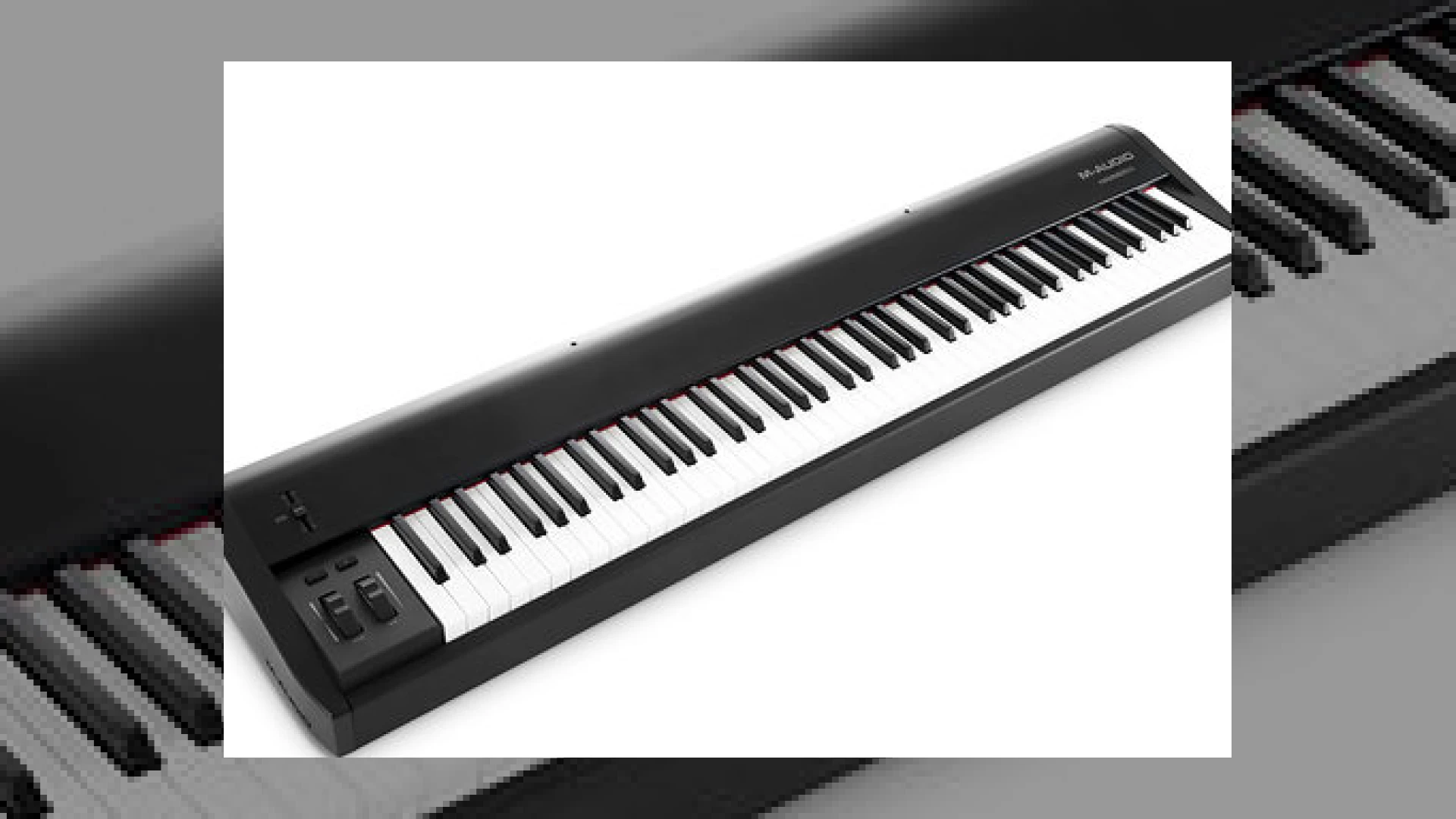
Visual context for M-Audio release 88-key hammer-action MIDI controller.
In the evolving landscape of virtual instruments and digital audio workstations, keybed response remains a defining factor for expressive composition. Here at SM Mastering, we frequently analyze how hardware controllers translate tactile performance into precise digital data. With the market often divided between expensive, feature-heavy workstations and lightweight synth-action keyboards, the brand new M-Audio release 88-key hammer-action MIDI controller has arrived to bridge the gap, offering a premium piano feel at a highly competitive price point of £379 / $399.
For session keyboardists, film composers, and project studio owners, capturing the nuanced dynamics of a grand piano requires physical weight and mechanical resistance. This new keyboard answers that demand directly, delivering 88 full-size, fully-weighted keys without forcing musicians to invest in unnecessary knobs, faders, or synthesis engines. By keeping the design streamlined, the focus remains entirely on performance accuracy and physical playability.
The Architecture of the M-Audio Release 88-Key Hammer-Action MIDI Controller
With the M-Audio release 88-key hammer-action MIDI controller, composers gain access to an instrument-grade keybed designed to emulate the mechanical escapement and hammer inertia of an acoustic piano. This level of physical response is notoriously difficult to engineer at budget-friendly price points, making this release a significant milestone for home studios and touring professionals alike.
Power delivery is exceptionally clean. The unit is completely bus-powered over USB, removing clutter from your studio desk. For those who wish to bypass computers entirely, the controller features a hardware 5-pin MIDI Out port. When triggering external hardware synthesizers or sound modules, you can power the unit using an optional external mains adaptor. Furthermore, its class-compliant USB connection ensures plug-and-play functionality with iOS devices, allowing for ultra-portable setups using an iPad and virtual sound generators in apps such as Apple’s GarageBand or Ableton Link-enabled software.
While stripped down in appearance, the controller retains essential performance modulators. A unity-locking pitch wheel and a dedicated modulation wheel allow for fluid pitch bends, portamento, and glissando effects. Additionally, a assignable Master Volume Fader is built in, which can be easily mapped to any MIDI-assignable parameter within your DAW—such as filter cutoff, expression, or expression dynamics. Dedicated Up and Down buttons let you navigate program changes, octaves, or MMC messages on the fly, all customizable via the included Hammer 88 Controller Editor software.
Hardware Specifications
To see how this controller fits into your existing production space, review the core specifications outlined below:
| Product Name | Primary Use | Estimated Price | Expert Rating |
|---|---|---|---|
| M-Audio Hammer 88 | Studio Composition, Virtual Instrument Control, Live Performance | £379 / $399 | 9.2 / 10 |
Practical Studio Workflow Tips
When integrating the M-Audio release 88-key hammer-action MIDI controller into your virtual instrument configuration, proper optimization is key to achieving natural dynamics:
- Adjust Velocity Curves: Use the companion Hammer 88 Controller Editor to match the velocity curve of the keybed to your software instruments. Heavy curves work best for delicate cinematic pianos, while lighter curves benefit fast-tempo orchestral brass runs.
- Expression Mapping: Assign the onboard master fader to MIDI CC #11 (Expression) or CC #1 (Modulation) to control the timbre and volume of orchestral libraries dynamically with your left hand while playing.
- Dual-Connectivity Setup: Use the USB port to control your primary DAW, while simultaneously routing the 5-pin MIDI Out to a secondary hardware synthesizer for layered, lag-free sound design.
For more detailed guides on optimizing MIDI data for clean mixing and mastering prep, explore our technical library at SM Mastering Audio Articles.
Conclusion
Ultimately, the M-Audio release 88-key hammer-action MIDI controller represents an exceptional entry point for anyone seeking authentic piano action without paying for excess physical controls. It strips away the superficial clutter to prioritize what matters most: the connection between the performer’s fingers and the digital sound engine. Whether you are tracking delicate grand piano passages or driving massive orchestral arrangements, this controller delivers elite playability at an accessible price point.
Frequently Asked Questions
Does the M-Audio Hammer 88 require an external power supply?
No, the controller is fully bus-powered via USB when connected to a computer or compatible iOS device. An optional 9V DC 800mA power supply is only required when using the 5-pin MIDI output to control external hardware synthesizers without a computer connected.
Can I connect expression and sustain pedals to this controller?
Yes, the Hammer 88 includes dedicated inputs on the rear panel for a Sustain pedal, Soft pedal, and Expression pedal, allowing for full three-pedal piano emulation and continuous hands-free expression modulation.
Is this controller compatible with both Windows and macOS?
Yes, the device is completely class-compliant on both macOS and Windows operating systems. It requires no manual driver installations and will be instantly recognized by all major digital audio workstations upon connection.
🛒 Official Product Info & Where to Buy
Check full technical specs, pricing, and purchase options directly from the official manufacturer or authorized dealer for M-Audio release 88-key hammer-action MIDI controller.
Written by SM Mastering
Official content on sound engineering, mixing, mastering, and advanced electronic production by SM Mastering.