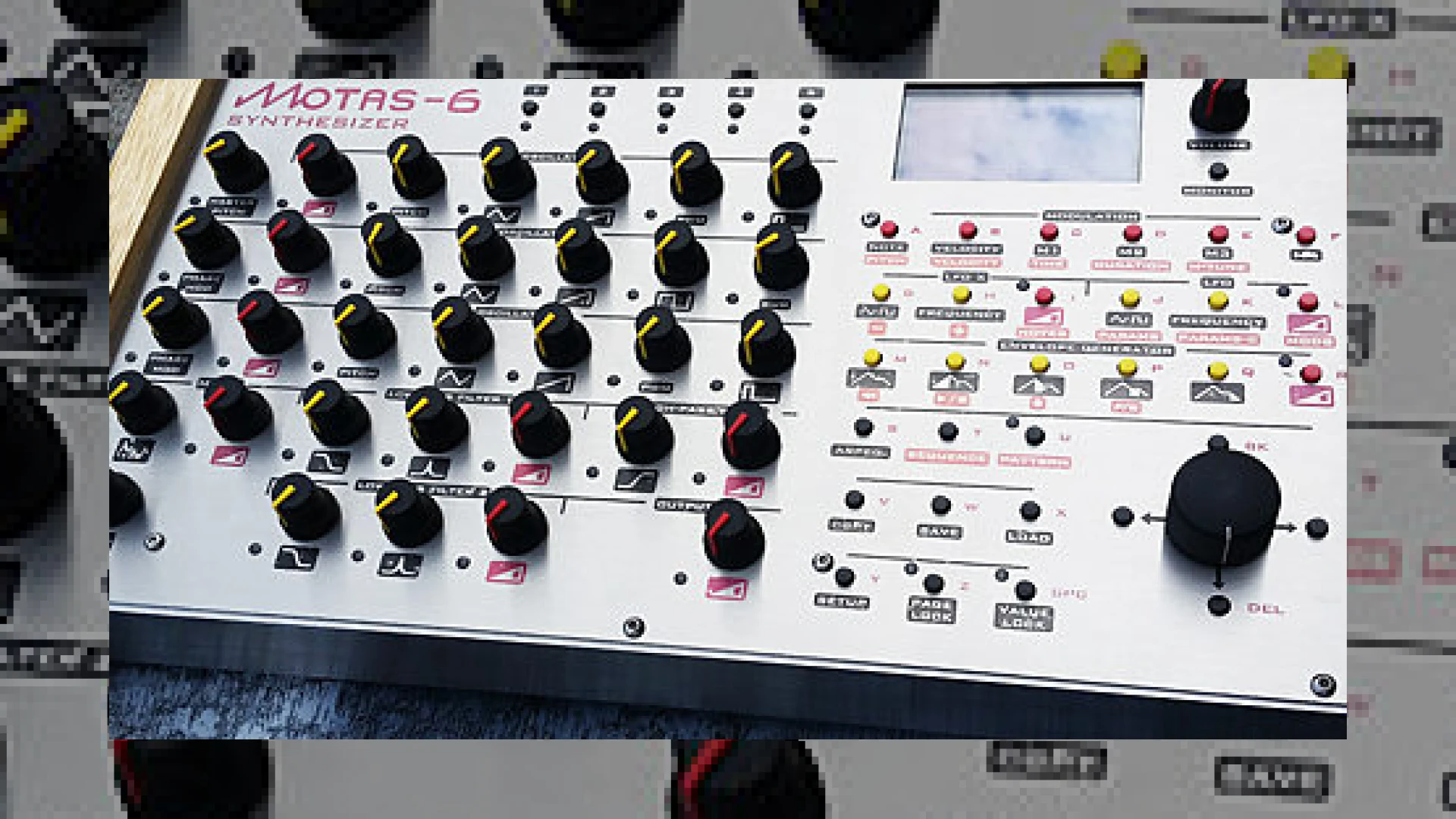
Visual context for Motas-6 monophonic analogue synthesizer.
At SM Mastering, we often encounter hardware that pushes the boundaries of modern sound design, and the latest creation from Motas Electronics is no exception. Today, we dive deep into the unique architecture of the motas-6 monophonic analogue synthesizer, a machine designed to bridge the gap between pure, rich analogue warmth and complex, modern digital control. For electronic music producers and mastering engineers looking to inject raw character into their tracks, this device represents a fascinating shift in boutique synthesizer design.
Unpacking the motas-6 monophonic analogue synthesizer
The sound generation engine of the motas-6 monophonic analogue synthesizer features three true analogue voltage-controlled oscillators (VCOs) instead of digitally controlled or numerically controlled oscillators (DCOs/NCOs). This choice guarantees a naturally drifting, organic harmonic foundation. Each oscillator supports independent tracking options, permitting highly flexible paraphonic playing styles. It also includes robust oscillator sync and analogue phase modulation options, making it capable of generating highly complex, evolving waveforms that mimic vintage classic gear while carving out its own distinct sonic signature.
Advanced Filtering and Routing Options
With filtering being critical to analogue design, Motas Electronics has integrated three highly powerful filter paths. You get a 6-pole voltage-controlled low-pass filter with self-oscillating resonance, a 4-pole low-pass filter, and a 2-pole high-pass filter. These three independent filters can be routed in series, parallel, or mixed dynamically to the final voltage-controlled amplifier (VCA). This routing flexibility allows producers to sculpt everything from earth-shaking sub-bass lines to screaming, resonant leads that sit perfectly in a busy mix.
A New Paradigm in Modulation
Modulation is where the motas-6 monophonic analogue synthesizer truly outperforms most of its contemporary competitors. Rather than relying on a simple, shared modulation matrix, every single rotary knob parameter on the interface is equipped with its own dedicated Envelope Generator (EG) and Low-Frequency Oscillator (LFO). This results in an unprecedented 37 EGs and 37 LFOs available simultaneously. Each LFO has 50 onboard waveforms (ranging from standard sine, triangle, and pulse waves to complex shapes, bursts, and sequence-style patterns). The four global LFOs can sync to MIDI, CV/gate, or internal clocks, making it an excellent partner alongside DAW environments like Ableton or modular analogue systems.
Motas-6 Hardware Specifications
| Product Name | Primary Use | Estimated Price | Rating |
|---|---|---|---|
| Motas-6 | Lead & Bass Sound Design, Paraphonic Synthesis, Studio Production | £1,195 | 4.8 / 5 |
Practical Studio Workflow Tips
When configuring the motas-6 monophonic analogue synthesizer in a professional environment, keeping a structured signal flow is paramount. Here are a few studio tips from our mastering perspective:
- Precise Gain Staging: Because of the three distinct filters and potential self-oscillation, watch the output levels to prevent unwanted digital clipping before your A/D converters.
- Parallel Processing: Use the multiple filter outputs to route clean and heavily modulated signals separately in your DAW, creating incredibly wide stereo images in your mix.
- Analog Saturation: Pair this synthesizer with premium outboard processors to enhance its natural analogue phase modulation and add subtle harmonic tape-style saturation.
If you are looking for more tips on preparing your synthesizer tracks for professional mastering, be sure to check out our SM Mastering Audio Articles library.
Conclusion
Ultimately, the motas-6 monophonic analogue synthesizer stands as an absolute powerhouse for synthesis purists and modern sound designers alike. By pairing uncompromising analogue VCOs and filters with a mind-boggling digital modulation matrix, Motas Electronics has created a future-proof classic that deserves a central spot in any high-end production studio.
Frequently Asked Questions
Is the Motas-6 a paraphonic or strictly monophonic synthesizer?
While it is primarily a monophonic synthesizer, the three independent analogue VCOs feature separate pitch tracking options, allowing for unique paraphonic playing capabilities and rich chord-like textures.
How many LFOs are available on the Motas-6?
The synthesizer features an incredible total of 37 dedicated LFOs and 37 EGs (one for each rotary knob parameter), plus four global LFOs capable of syncing to internal, MIDI, or CV/gate clocks.
What type of filters does the Motas-6 use?
It houses three independent analogue filters: a 6-pole resonant low-pass filter, a 4-pole low-pass filter, and a 2-pole high-pass filter, which can be chained and mixed in multiple configurations.
🛒 Official Product Info & Where to Buy
Check full technical specs, pricing, and purchase options directly from the official manufacturer or authorized dealer for Motas-6 monophonic analogue synthesizer.

Written by SM Mastering
Official content on sound engineering, mixing, mastering, and advanced electronic production by SM Mastering.