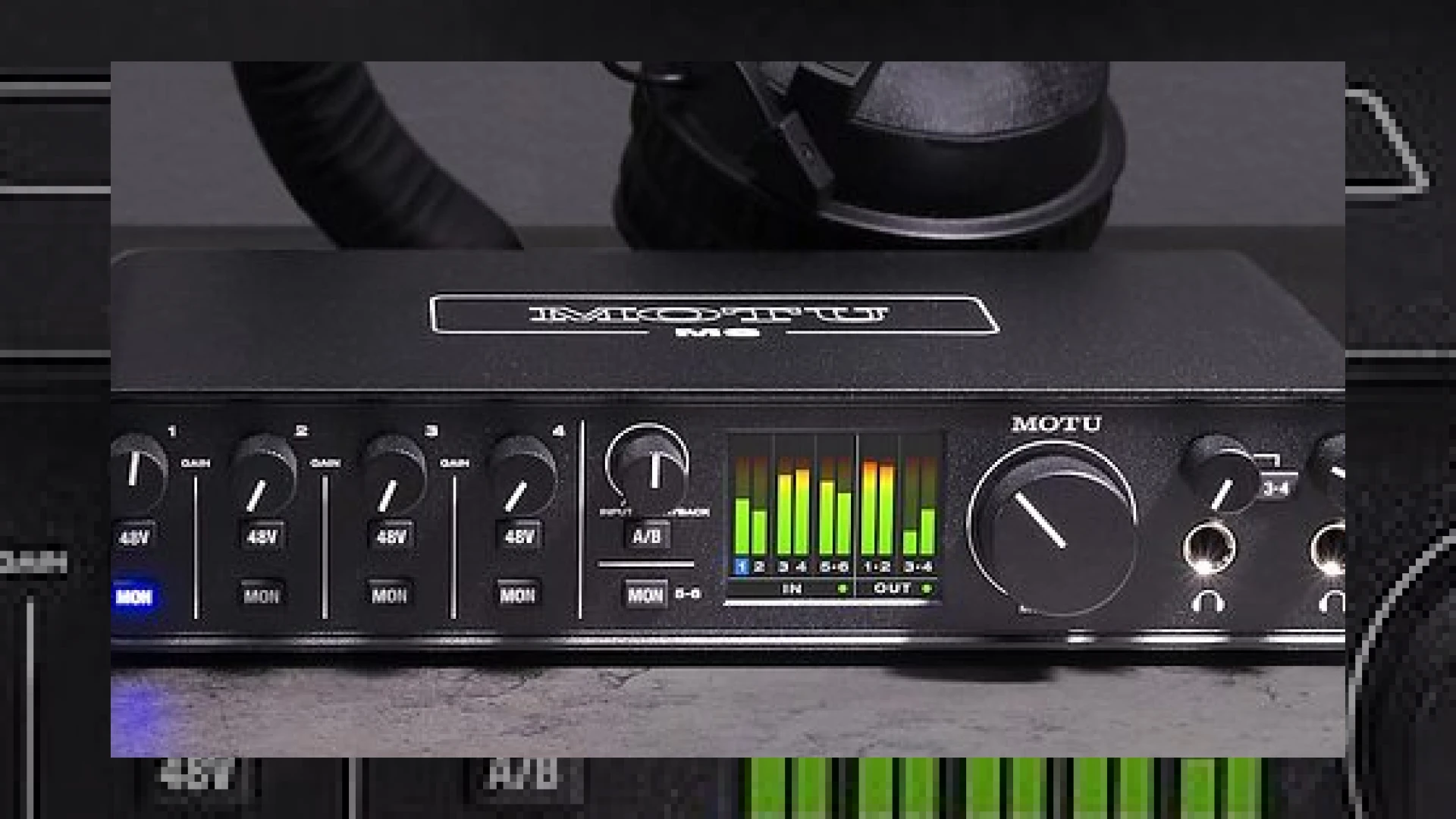
Visual context for MOTU release M6 audio interface.
When MOTU announced the **motu release m6 audio interface**, project studio owners and mobile producers took immediate notice. At SM Mastering, we put a lot of hardware through rigorous testing to evaluate conversion quality, preamp transparency, and driver stability. Bridging the gap between compact desktop convenience and professional studio connectivity, the hardware brings high-end ESS Sabre32 Ultra DAC technology to a bus-powered six-input, four-output form factor. In this breakdown, we will explore the technical specifications, workflow advantages, and acoustic capabilities that make this interface a compelling choice for modern creators.
Technical Specifications and Build Quality of the motu release m6 audio interface
Beneath the sleek exterior, the engineering choices behind the **motu release m6 audio interface** are designed to satisfy demanding audio professionals. The conversion is handled by ESS Sabre32 Ultra DAC technology, delivering an impressive 120dB dynamic range (A-weighted) on the main outputs. Preamps feature an equivalent input noise (EIN) rating of -129 dBu, ensuring clean gain staging whether you are tracking delicate acoustic instruments or driving dynamic microphones.
For further insights into professional mixing workflows, you can consult SM Mastering Audio Articles for expert guides on gain staging and signal flow. Furthermore, mastering engineers often check out external processing tools like those found at iZotope to complement their tracking chains.
| Name | Use | Price | Rating |
|---|---|---|---|
| MOTU M6 | 6-In / 4-Out USB Audio Interface | Mid-Tier Desktop | 4.8 / 5 |
Advanced Features of the motu release m6 audio interface
Beyond pure conversion numbers, the **motu release m6 audio interface** introduces several utility-driven features tailored for modern creators. The inclusion of two independent headphone outputs means tracking sessions with a collaborator become seamless, while dedicated front-panel A/B monitor switching allows engineers to reference mixes on two separate sets of studio monitors instantly.
Moreover, the device offers full-color LCD metering for all inputs and outputs, giving you immediate visual feedback on levels without needing to squint at software meters. Low-latency drivers enable round-trip latency times down to 2.5ms at 96kHz, and the built-in Loopback feature makes it exceptionally easy to route system audio for podcasting, streaming, or sampling directly into your DAW.
Practical Studio Workflow Tips
To maximize the performance of the **motu release m6 audio interface** in your acoustic environment, consider the following workflow strategies:
* **Leverage Stand-Alone Mode:** Use the stand-alone operation feature when you need a multi-channel preamp system or headphone distribution amp without having a computer booted up.
* **Optimize Monitor A/B Switching:** Calibrate your primary studio monitors and secondary reference speakers closely so that toggling the front panel A/B switch yields a true translation check.
* **Utilize Loopback Wisely:** When recording internal computer audio alongside live microphones, set up clear sub-mixes to prevent phase cancellation and feedback loops.
Conclusion
Ultimately, the **motu release m6 audio interface** delivers professional-grade specifications, robust hardware controls, and ultra-low latency performance in a flexible package. Whether you are building out a home production suite or need a reliable, high-end mobile rig, MOTU has crafted a tool that punches well above its weight class.
Frequently Asked Questions
Does the MOTU M6 require an external power supply?
Yes, while it can be bus-powered via USB-C depending on your setup, it also ships with a DC power supply to ensure stable operation across all six inputs and dual headphone amplifiers.
Can I monitor my inputs without a computer connected?
Yes, the M6 supports stand-alone operation, allowing you to monitor and route all inputs without an active computer connection.
How low is the round-trip latency?
Thanks to optimized MOTU drivers, the interface can achieve round-trip latency times as low as 2.5ms (measured at 96 kHz with a 32-sample buffer).
🛒 Official Product Info & Where to Buy
Check full technical specs, pricing, and purchase options directly from the official manufacturer or authorized dealer for MOTU release M6 audio interface.

Written by SM Mastering
Official content on sound engineering, mixing, mastering, and advanced electronic production by SM Mastering.