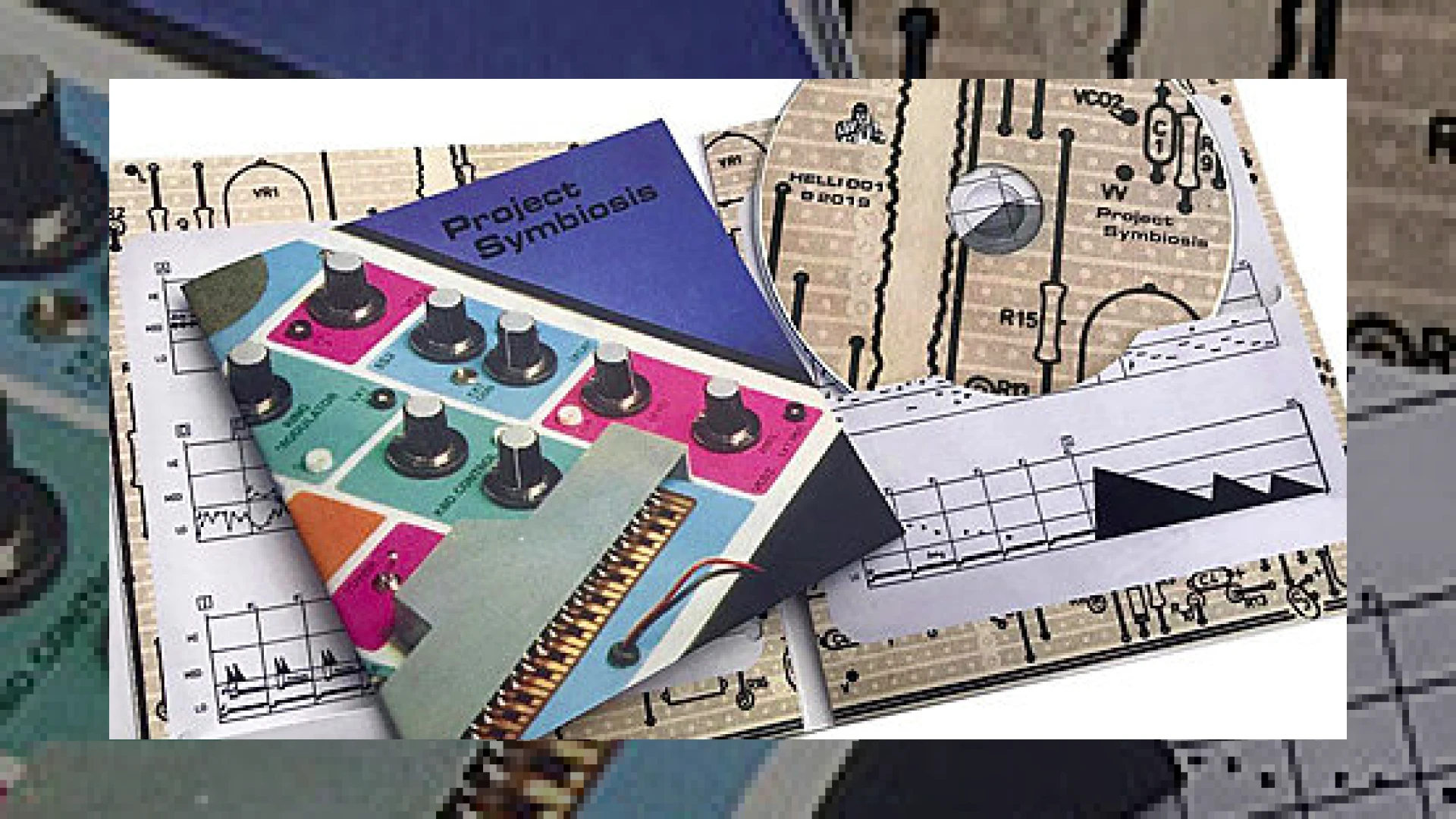
Visual context for Project Symbiosis.
The intersection of vintage hardware design and experimental composition remains one of the most fascinating areas of audio engineering. Recently, the music technology community has seen a resurgence of interest in historical synthesizers and the avant-garde methodologies of the 1970s. This historic release, project symbiosis, presents an invaluable study for modern audio engineers, electronic music producers, and mastering experts alike. Originally conceived in 1975 as a graphic score by Malcolm Pointon for Practical Electronics magazine to accompany the Minisonic homebuild synthesizer construction project, it has been revitalized for a modern audience.
The Legacy and Compositional Framework of Project Symbiosis
To understand the sonic blueprint of this compilation, we must look at how the dynamic range of project symbiosis provides a playground for creative electronic music-makers. The compilation features ten distinct tracks, starting with Pointon’s original 1970s recordings and expanding into modern reinterpretations by artists using self-built and analog equipment. When analyzing project symbiosis from a mastering perspective, the primary challenge lies in balancing the highly divergent frequency spectra of completely different homebuilt instruments while preserving the raw, organic character of early analog synthesis.
Originally intended to encourage synthesizer builders to push the limits of their newly constructed hardware, the project highlights the transition from engineering to artistic expression. By using a graphic score instead of traditional sheet music, contributors were given the freedom to interpret frequency, modulation, and amplitude over time in a highly visual manner. This visual-to-audio translation creates complex, non-linear harmonic structures that require specialized mastering treatment to prevent modern digital playback systems from clipping.
Specifications & Technical Profile
| Name | Use | Price | Rating |
|---|---|---|---|
| Project Symbiosis CD | Analog Synthesis Reference & Historic Study | £10.00 | 4.8 / 5.0 |
Studio Workflow: Recreating Analog Symbiosis in Your DAW
Recreating the patching philosophy found in project symbiosis requires a blend of historic methodology and modern digital precision. Whether you are using vintage hardware or state-of-the-art software emulations like those from Universal Audio, you can harness graphic scoring to break free from traditional linear sequencing. Designers can translate visual representations into control voltage (CV) modulations to capture that authentic, unpredictable 1970s character.
To fully appreciate the scope of project symbiosis, one must learn how to handle unpredictable control voltages and raw waveforms in a contemporary hybrid mastering studio. For those interested in mastering these unique waveforms, our detailed guides over at the SM Mastering Audio Articles offer deep dives into spectral balancing and analog warmth. Managing DIY synthesis requires precise dynamic control, as hand-built oscillators often feature rich, uneven harmonics that can easily overwhelm a master bus.
- Tip 1: Map Graphics to LFOs: Use automation curves inside your DAW to replicate the graphical score’s lines, mapping them to filter cutoff and resonance rather than standard grid-based notes.
- Tip 2: Tame the Midrange: Homemade synthesizers often accumulate build-ups between 400Hz and 800Hz. Use dynamic EQ to control these regions only when they spike.
- Tip 3: Parallel Saturation: Introduce a subtle amount of tape saturation in parallel to glue the divergent transient responses of different self-built machines together.
Conclusion
Ultimately, this historic archive serves as a brilliant reminder that electronic music is at its best when it is experimental and deeply tactile. By bridging the gap between 1970s DIY ingenuity and modern mastering techniques, the compilation stands as an essential reference for anyone looking to understand the roots of synthesis and visual composition.
Frequently Asked Questions
What is the history behind Project Symbiosis?
It began as a 1975 feature in Practical Electronics magazine, showcasing an electronic music composition by Malcolm Pointon. It was designed to encourage hobbyists who built the Minisonic synthesizer to explore their instruments using a graphic score.
How does a graphic score differ from traditional notation?
Unlike standard musical notation, which dictates exact pitches and rhythms, a graphic score uses visual symbols, shapes, and patterns to guide the performer’s modulation, texture, and sonic progression over time.
Where can I listen to and buy this compilation?
The compiled works are available as a limited edition CD (including a 12-page explanatory booklet by Ian Helliwell) directly via Bandcamp for £10.00.

Written by SM Mastering
Official content on sound engineering, mixing, mastering, and advanced electronic production by SM Mastering.