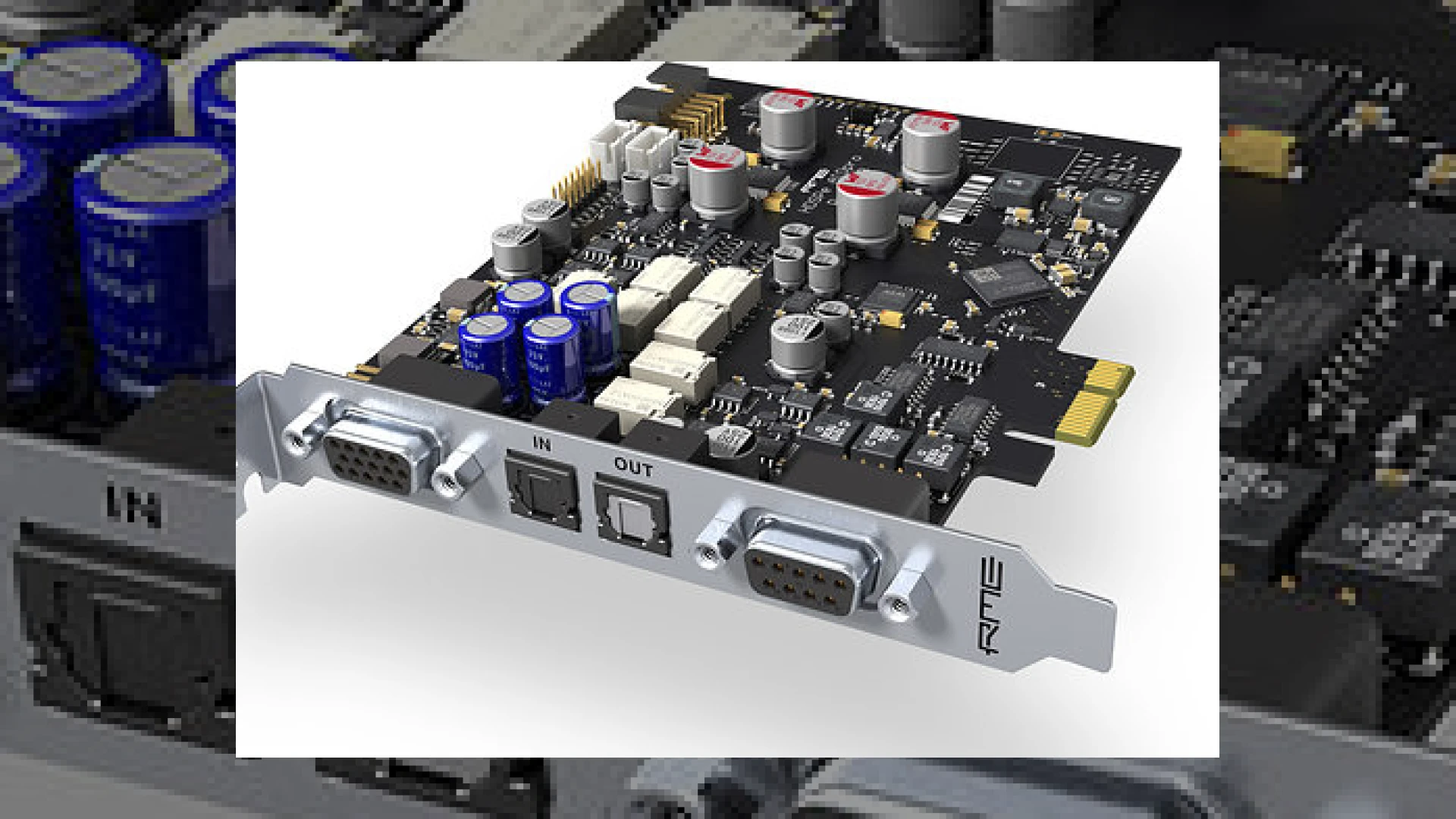
Visual context for RME announce HDSPe AIO Pro.
When industry leaders like rme announce hdspe aio pro, the professional audio community takes notice. In the high-stakes world of mastering and broadcast engineering, the PCI Express format remains the gold standard for ultra-low latency and robust stability. With this new release, RME has completely overhauled their classic PCIe card to deliver reference-class performance, combining cutting-edge digital clocking with highly refined analog circuitry.
The Audio Revolution: RME Announce HDSPe AIO Pro
As we analyze the news that rme announce hdspe aio pro, we see that they have upgraded every single component under the hood. While retaining the impressive 30-channel layout (14 inputs and 16 outputs), the internal architecture is entirely modernized. By adopting the legendary AK5572 and AK4490 converters—the same chips utilized in the critically acclaimed ADI-2 Pro AD/DA converter—this new PCIe card achieves unparalleled dynamic range and THD+N specifications.
For mastering studios, when rme announce hdspe aio pro, it signals an immediate upgrade in jitter reduction. The integration of SteadyClock FS is a massive milestone. Operating on a femtosecond scale (accurate to one quadrillionth of a second), SteadyClock FS optimizes conversion to and from analog with unmatched precision. This level of clocking accuracy pairs perfectly with high-end monitoring from Neumann, allowing engineers to hear transient details and stereo imaging with absolute transparency.
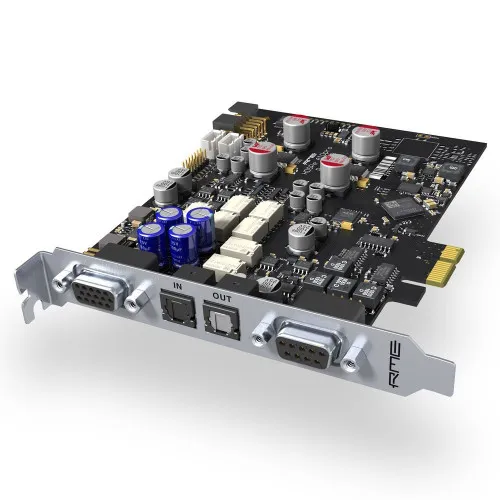
Additional product view and interface angle for RME announce HDSPe AIO Pro.
Advanced Analog Features and Input/Output Flexibility
Indeed, when rme announce hdspe aio pro, they aren’t just releasing a minor revision; they are redefining PCIe interfaces. The analog front end features newly developed reference levels (+24 / +19 / +13 / +4 dBu for balanced signals) matching the ADI-2 Pro design. Output stages also feature a dedicated attenuator, ensuring a stellar signal-to-noise ratio even when driving low reference levels. This attention to gain-staging makes it highly adaptable to boutique mastering consoles and legacy analog outboard gear.
We can confirm that as rme announce hdspe aio pro, the inclusion of the ADI-2 Pro’s converter design makes it an absolute powerhouse. It handles ADAT, SPDIF, AES/EBU, and MIDI I/O simultaneously. Additionally, the powerful headphone output now features a click-free relay-muting circuit, protecting your expensive headphones and monitors from startup pops when your computer boots up.
Technical Specifications
| Name | Use | Price | Rating |
|---|---|---|---|
| RME HDSPe AIO Pro | Professional Mastering, Recording, & Broadcast | Approx. $899 / £649 | 4.9 / 5.0 |
For more deep dives into professional converters, check out our collection of SM Mastering Audio Articles.
Practical Studio Workflow Tips
- Optimize Gain Staging: Utilize the hardware-based reference levels (+24 dBu down to -2 dBu) in TotalMix FX to match your analog outboard gear without digital attenuation. This preserves full dynamic range.
- Use SteadyClock FS as your Master Clock: Distribute the ultra-low jitter clock of the HDSPe AIO Pro via ADAT or SPDIF to synchronize secondary converters in your facility.
- Leverage TotalMix Loopback: Set up internal loopback routing for seamless reference tracking, podcasting, or routing audio between different DAWs without leaving the digital domain.
Conclusion
The RME HDSPe AIO Pro is a testament to RME’s dedication to reliability and audio quality. By bringing the conversion prowess of the ADI-2 Pro directly onto a high-bandwidth PCIe card, mastering engineers and broadcast professionals can now enjoy state-of-the-art conversion with the lowest possible latency on the market. It is a formidable tool that promises to anchor professional studios for another decade.
Frequently Asked Questions
What is SteadyClock FS and why does it matter?
SteadyClock FS is RME’s proprietary digital clocking technology based on a femtosecond clock. It reduces jitter to an all-time low, ensuring highly detailed stereo imaging, transient accuracy, and a clean, distortion-free conversion process across all formats.
Can all inputs and outputs of the HDSPe AIO Pro be used simultaneously?
Yes. The HDSPe AIO Pro supports up to 30 channels (14 input and 16 output) simultaneously, covering ADAT, SPDIF, AES/EBU, MIDI, and analog I/O, managed seamlessly by the onboard DSP-based TotalMix mixer.
How does the HDSPe AIO Pro protect my monitors during startup?
The card features an advanced hardware relay-muting circuit on both the analog outputs and the dedicated headphone amplifier. This physically disconnects the outputs during computer startup and shutdown to prevent pops and thumps from damaging your gear.
🛒 Official Product Info & Where to Buy
Check full technical specs, pricing, and purchase options directly from the official manufacturer or authorized dealer for RME announce HDSPe AIO Pro.

Written by SM Mastering
Official content on sound engineering, mixing, mastering, and advanced electronic production by SM Mastering.