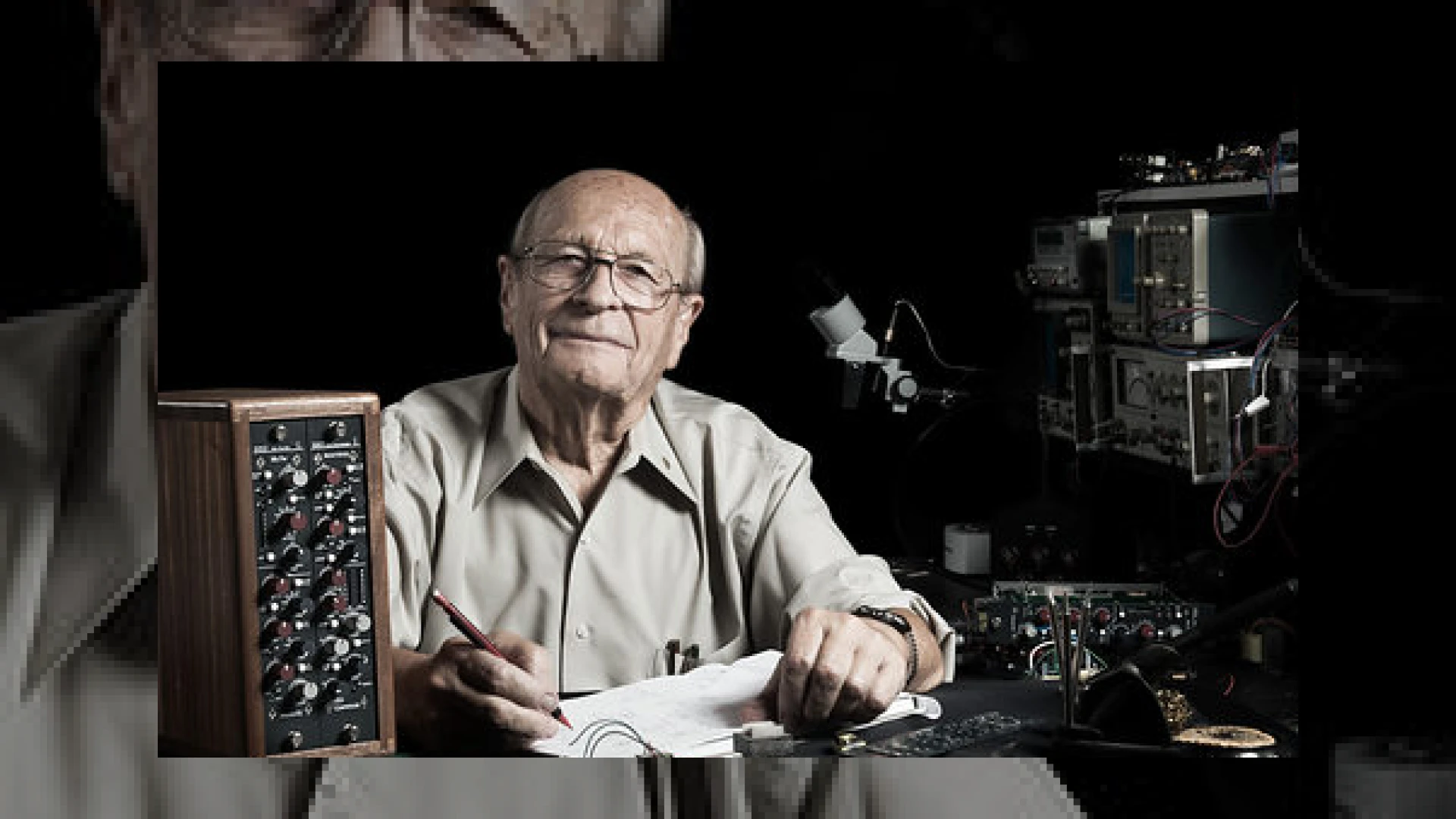
Visual context for Rupert Neve 1926-2021.
The pro audio world changed forever with the passing of the industry’s most revered analog designer, and honoring the legacy of rupert neve 1926-2021 is essential for understanding modern recording history. As mastering and mix engineers, we continuously interact with the sonic signatures he perfected over his long career. From the legendary 1073 preamplifier module to the custom winding of class-A audio transformers, his structural innovations established the industry benchmarks for analog warmth, low-frequency phase coherence, and pristine headroom. At SM Mastering, we often analyze how classic vintage console topology shapes today’s digital masters, making his life’s work a cornerstone of our educational resources available via SM Mastering Audio Articles.
The Technical Philosophy of Rupert Neve 1926-2021
The career of rupert neve 1926-2021 spanned over seven decades, during which he founded Neve Electronics in 1961 and pioneered early solid-state console designs. His transition from vacuum tubes to transistors in the mid-1960s resulted in modular preamps and equalizers that defined the “British Sound.” Engineers worldwide sought after the unique harmonic coloration produced by his custom-designed transformers, which added subtle second-order harmonic distortion without sacrificing low-frequency clarity. Even in the digital era, software manufacturers like Universal Audio meticulously model these hardware circuits to capture the distinct saturation characteristics that rupert neve 1926-2021 introduced to the recording chain.
Beyond his early work, his designs for Focusrite, Amek Systems, and his final venture, Rupert Neve Designs (RND), continued to push the boundaries of high-fidelity analog equipment. By prioritizing ultra-wide bandwidths (often extending well past 100 kHz) and minimal crossover distortion, he ensured that his processors preserved the micro-dynamic details of transient-heavy material. When studying the technical innovations of rupert neve 1926-2021, it becomes clear why his legacy is felt in every modern commercial hybrid studio today.
Iconic Hardware Specifications
The following table outlines some of the most influential hardware designs associated with his engineering journey, detailing their primary functions and modern industry standings.
| Name | Use | Price (Approx. USD) | Rating |
|---|---|---|---|
| Neve 1073 Channel Amp | Mic Preamp / 3-Band EQ | $3,500 | 5.0 / 5.0 |
| Neve 2254 | Diode-Bridge Compressor | $4,200 (Vintage/Reissue) | 4.8 / 5.0 |
| RND Portico II Master Buss Processor | Stereo Dynamics & Silk Control | $4,299 | 4.9 / 5.0 |
| Focusrite ISA 110 | Console Preamp / Equalizer | $2,000 (Used) | 4.7 / 5.0 |
Practical Studio Workflow Tips
Applying the engineering principles of rupert neve 1926-2021 in a modern hybrid studio environment requires a deep understanding of analog gain staging and transformer behavior. Here are three expert tips for integrating his sonic signature into your workflow:
- Drive Transformers for Subtle Saturation: Neve preamps and processors are designed to handle high input levels. By driving the input stage of a 1073 or a modern RND Portico unit while backing off the output fader, you can generate pleasing harmonic saturation that glues a mix together.
- Utilize the Fixed High-Shelf for “Air”: The legendary 12 kHz high-frequency band on the 1073 EQ features a smooth, musical curve. Do not hesitate to boost 2–4 dB on vocals or overheads to add high-end sheen without causing digital harshness.
- Experiment with Silk Modes: If you are using modern Rupert Neve Designs gear, experiment with the “Red” and “Blue” Silk modes. Red enhances mid-to-high frequency harmonics for presence, while Blue targets low-to-mid harmonics to thicken thin sources like bass guitars or kick drums.
Conclusion
Ultimately, the era of rupert neve 1926-2021 gave us the physical blueprint for high-end professional audio. His commitment to musicality, transformer design, and uncompromising quality ensured that his name remains synonymous with sonic excellence. Whether you are working with vintage hardware consoles, modern outboard gear, or advanced digital modeling plugins, his influence remains an indispensable part of the recording, mixing, and mastering processes.
Frequently Asked Questions
What is the “Neve Sound” and why is it so famous?
The “Neve Sound” is characterized by its warmth, punchy low-end, and extremely smooth mid-range. This sonic signature is primarily produced by custom-wound transformers and Class-A discrete circuitry, which introduce pleasing analog harmonics and soft-knee saturation when pushed.
What is the difference between vintage Neve gear and Rupert Neve Designs?
Vintage Neve gear refers to products manufactured by Neve Electronics prior to 1975, utilizing classic components like discrete transistors and early transformer designs. Rupert Neve Designs (RND) is the company founded in 2005 that features modern, low-noise topology, wider frequency responses, and features like Silk harmonic control, blending classic tone with modern precision.
How can I replicate Neve hardware coloration using plugins?
You can replicate this classic coloration by using high-quality console emulations and pre-amplifier modeling plugins. Insert a console channel strip plugin on every track of your session, drive the input stage slightly, and use small EQ boosts to emulate the cumulative harmonic complexity of a real analog mixing console.
Written by SM Mastering
Official content on sound engineering, mixing, mastering, and advanced electronic production by SM Mastering.