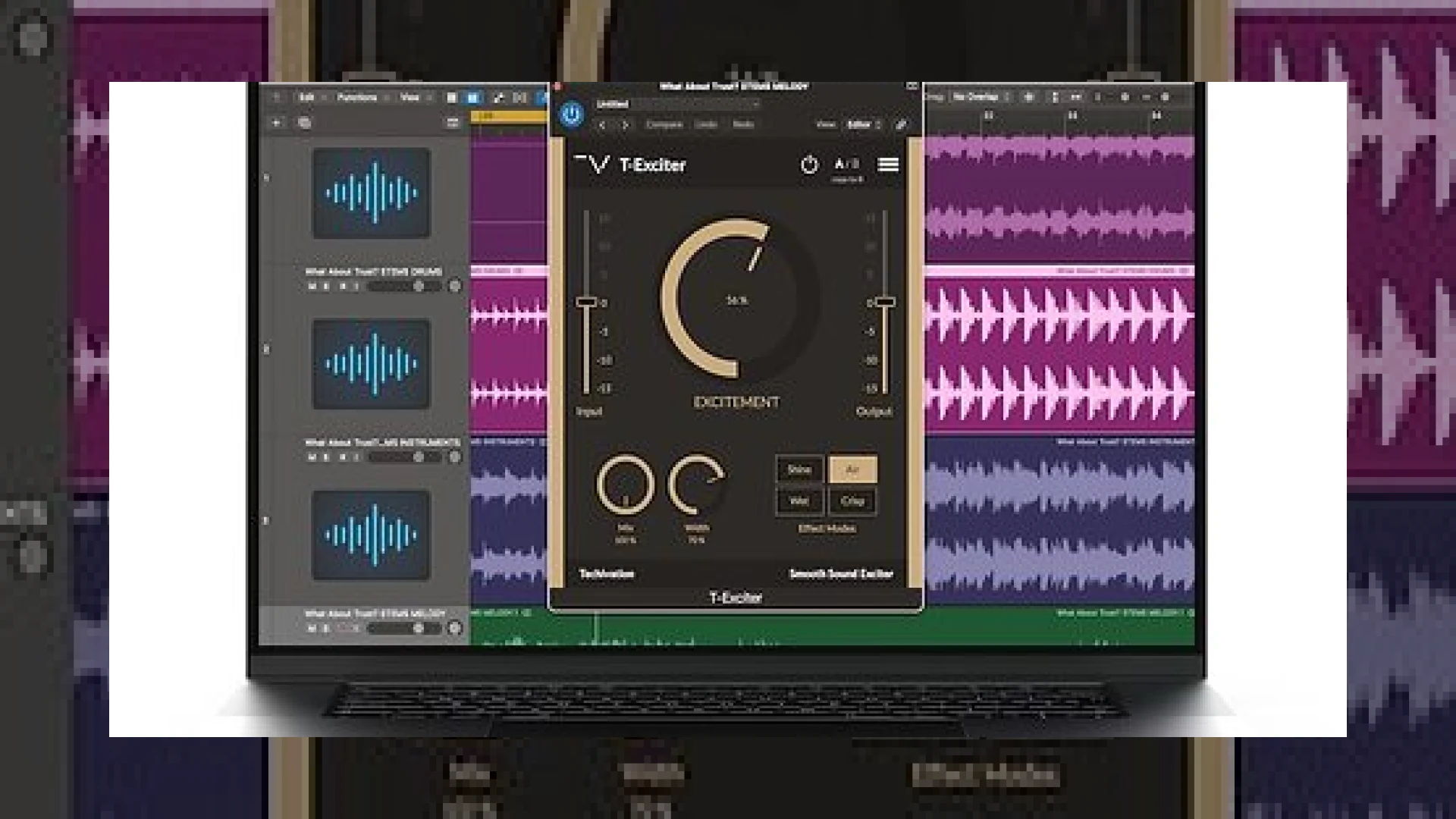
Visual context for T-Exciter plug-in from Techivation.
Here at SM Mastering, we constantly test the latest processing tools to evaluate their viability in professional mixing and mastering workflows. Harmonic enhancement and stereo field manipulation are crucial steps when bringing a mix from “good” to “radio-ready.” Recently, developers have focused heavily on combining modern mathematical precision with analog-inspired character. A prime example of this trend is the **t-exciter plug-in from techivation**, a streamlined processor designed to inject life, air, and width into individual tracks, instrument buses, and full mixes alike.
In this technical breakdown, we will explore the core architecture, sonic modes, and practical studio applications of the **t-exciter plug-in from techivation** to help you decide how to integrate it into your sessions.
Core Architecture and Features of the T-Exciter Plug-in from Techivation
Techivation is well-known for creating utilitarian, minimalist interfaces that prioritize rapid workflow without sacrificing audio fidelity. Following the design language of their popular T-De-Esser and T-Clarity processors, the **t-exciter plug-in from techivation** features a clean, scalable GUI that supports high-resolution displays up to 150%.
At the center of the user interface sits a large, responsive macro dial that controls the overall intensity of the saturation and excitation processing. To maintain proper gain staging, dedicated input and output gain controls flank the main processing window. Furthermore, the inclusion of a wet/dry mix control allows mixing engineers to implement parallel harmonic enhancement effortlessly, preserving the natural low-end transients of the source material while introducing upper-frequency excitement.
When configuring your digital audio workstation for optimal performance, you might also want to reference industry standards for signal flow and dynamics, such as the hardware-emulation philosophies found at Universal Audio.
Sound Modes and Stereo Enhancement
Versatility is paramount in modern music production, and this processor delivers through four distinct harmonic generation modes:
* **Shine:** Adds a smooth, glossy sheen to vocals and acoustic instruments.
* **Air:** Targets ultra-high frequencies to give mixes an expensive, open top-end sparkle.
* **Wet:** Imparts a denser, more saturated character that works wonders on synth leads and electronic drums.
* **Crisp:** Enhances upper-mid clarity, helping guitars and aggressive percussion cut through a dense arrangement.
In addition to harmonic saturation, the built-in stereo width control provides seamless manipulation of the spatial image. Whether you need to gently widen a backing vocal bus or narrow a low-end sub-group, the spatial processing maintains mono compatibility remarkably well. For deeper insights into professional mixing and mastering chains, check out our comprehensive SM Mastering Audio Articles.
Technical Specifications
| Specification | Details |
|---|---|
| Name | T-Exciter |
| Use | Harmonic Excitation and Stereo Width Processing |
| Price | Check official Techivation website for current pricing and tiers |
| Rating | 4.8 / 5 (SM Mastering Editor’s Choice) |
Practical Studio Workflow Tips
To maximize the potential of the **t-exciter plug-in from techivation** during your sessions, consider these professional engineering tips:
1. **Parallel Vocals:** Insert the processor on a dedicated auxiliary track rather than directly on the lead vocal channel. Blending a heavily “Air” or “Shine” mode-processed signal underneath the dry vocal adds presence without introducing digital harshness.
2. **Drum Bus Glue:** Use the “Crisp” mode subtly on a drum bus with a low wet/dry mix percentage to bring out room ambiance and snare crack.
3. **A/B Comparison:** Utilize the built-in A/B switch and undo/redo functionality to verify that your adjustments are genuinely improving the track rather than just making it louder.
Conclusion
The **t-exciter plug-in from techivation** successfully bridges the gap between deep sonic control and fast, intuitive operation. By offering four tailored saturation modes alongside flexible stereo imaging and parallel processing capabilities, it stands out as a reliable addition to any mixing or mastering engineer’s digital toolkit.
Frequently Asked Questions
Is the t-exciter plug-in from techivation compatible with Apple Silicon M1 and M2 processors?
Yes, the plug-in features native support for Apple Silicon M1 and M2 processors, ensuring high performance and energy efficiency on modern Mac computers.
What plugin formats are supported?
It is available in VST, VST3, and AAX formats for Windows, and VST, VST3, AU, and AAX formats for macOS.
Can I use this processor on a master bus?
Absolutely. Thanks to its transparent processing options, gentle gain staging controls, and precise stereo width manipulation, it works exceptionally well on stereo master buses when used with subtlety.
🛒 Official Product Info & Where to Buy
Check full technical specs, pricing, and purchase options directly from the official manufacturer or authorized dealer for T-Exciter plug-in from Techivation.
Written by SM Mastering
Official content on sound engineering, mixing, mastering, and advanced electronic production by SM Mastering.